What Sets the MOQ for Custom Hoodies? A Manufacturer's Guide
- A hoodie MOQ is not a number a factory invents over coffee. It is the sum of several costs that do not shrink when the order shrinks: one dye lot, one cutting marker, one machine changeover, one pattern grading, one set of screens and embroidery tapes. The fewer pieces you spread them across, the more each piece has to carry, so a low minimum always carries a premium unless you remove some of those costs yourself.
- What actually drives a minimum up is usually not "100 pieces or 300 pieces" but the number of colors multiplied by the number of sizes. The same 100 pieces in one color across three sizes is the cheapest way to cut it. Split into 3 colors x 4 sizes, you have 12 SKUs at roughly 8 pieces each, and dyeing, cutting, thread changes and inspection all triple while every individual run gets shorter.
- There are five legitimate ways to bring a minimum down: use a stock fabric in a stock color, cut the number of colors, consolidate sizes, accept the small-run surcharge openly, and move the expensive custom trims to the reorder. What you should not do is accept a suspiciously low minimum that nobody can explain, because it is usually built from leftover stock fabric that will never match on reorder.
- Hoodie MOQ is not a number, it is a set of fixed costs
- A Pitfall Case Worth Reading
- Fabric: the hardest constraint for custom hoodies
- Colors and Sizes: 100 Pieces Across 12 SKUs
- Trims and custom hoodie items each have their own minimum
- The Line: Changeovers Are the Hidden Gate
- Processes: Printing, Embroidery and Washing Run in Batches
- Six Factors, Side by Side
- Three Ways to Split the Same 100 Pieces
- Five Legitimate Ways to Lower the Minimum
- What to Ask Before You Place the Order
- Common Questions
Hoodie MOQ Is Not a Number, It Is a Set of Fixed Costs
The question buyers ask most often is "what is your minimum for hoodies," and it is the wrong question. On the factory side, a minimum order quantity is not a sales posture. It is arithmetic. Inside every production run there are several costs you pay once whether the run is 50 pieces or 500: the dye vat gets filled once, the cutting marker gets made once, the machines get set up once, the pattern gets graded once, the screens and embroidery tapes get cut once. Cut the piece count and these costs do not shrink, so each piece has to absorb more of them. A factory that wants to stay solvent will either raise the unit price or raise the minimum. Once you can name those costs, you have something to negotiate with. Without them, you are just comparing numbers between suppliers and getting more confused with every quote.
This guide is not about how to choose a factory in the first place — we covered that separately in our hoodie manufacturer sourcing checklist — and it is not about private label ownership questions, which we dealt with in how to evaluate a private label hoodie manufacturer. This is only about one thing: where a minimum actually comes from. For a brand that already has a product plan and is about to spend real money on a bulk run, this is the cheapest lesson available, because the same total quantity can move the unit price by twenty or thirty percent depending on how you split it.
A Pitfall Case Worth Reading
A growing DTC streetwear brand launched its first hoodie line with five colorways and six sizes, 300 pieces in total, which works out to roughly ten pieces per SKU. Two factories quoted. Factory A said plainly that splitting five ways meant a separate dye lot per color and that the unit price would have to go up. Factory B said yes to everything: 300 pieces, five colors, priced as if it were a bulk run. The brand chose Factory B. Then bulk production started. Three of the five colorways turned out to be approximations stitched together from leftover stock fabric, and none of them matched the approved sample. Delivery ran three weeks late because low marker efficiency on fragmented sizes kept pushing the job behind larger orders. The worst part came three months later at reorder: the stock fabric was gone, the same colors could not be reproduced, and the brand had to resample and recolour from scratch, losing a month of sales on its best-selling piece.
Factory B did not exactly lie. It really did produce 300 pieces in five colors. It just never told the buyer how it managed it. Factory A's warning about a higher unit price was the honest answer, because it was spreading the fixed costs into the quote where the buyer could see them. So the point of understanding MOQ is not whether the number is high or low. It is knowing which costs have been spread openly and which have been quietly hidden. The next six sections take those costs apart one by one.
Fabric: The Hardest Constraint for Custom Hoodies
Hoodie fabric, whether French terry or brushed fleece, is the hardest part of any minimum because the constraint sits at the dye house, not at the sewing line. A dye vat has a minimum load, usually several hundred kilos at a time. A 100-piece hoodie order consumes a few dozen kilos of fabric, nowhere near enough to justify filling a vat on its own. That leaves two routes. Either you use a stock color the factory already runs — greys, blacks, navies and similar staples that can share a vat with other orders, which keeps the minimum low — or you specify a custom color and accept the dye lot minimum, with the surplus fabric either held as your reorder reserve or paid for outright.
Fabric weight plays into the same calculation. Between roughly 280 GSM and 500 GSM, a heavier fabric consumes more kilos per garment, which sounds like it should raise the minimum, but in practice heavy fabrics are sometimes easier to schedule because the order reaches the dye minimum faster. What genuinely causes trouble is a standard weight in a non-standard color: no stock fabric to share, and not enough volume to justify its own lot. That combination is where buyers get pushed into surcharges. We wrote separately about choosing between French terry and brushed fleece and how to settle on a weight, in our hoodie fabric guide.

Colors and Sizes: 100 Pieces Across 12 SKUs
This is the factor buyers most often underestimate. Take the same 100 pieces. In one color across three sizes, say 20 small, 40 medium and 40 large, the dye vat runs once, the cutting marker is made once, the sewing line never changes thread, and inspection is straightforward. It is the cheapest possible split. Now split the same 100 pieces into 3 colors x 4 sizes, twelve SKUs averaging eight pieces each. The total is still 100, but the vat runs three times, the marker is planned three times, the line changes top and bobbin thread three times, print or embroidery placement is registered three times, and inspection has to cover twelve SKUs instead of three. The fixed costs roughly triple while every individual run drops to eight pieces, which cannot carry them.
There is a blunt rule of thumb in this industry: color count is the first multiplier on any minimum, size count is the second. If you want to control cost, those are the two places to start. Go single color and save the second colorway for the reorder. Pull a six-size run from XS to XXL back to S, M and L — hoodies are loose by nature and three sizes usually cover the bulk of the demand. This is not a factory being difficult; it is the physics of scheduling. At eight pieces per SKU, the fixed time spent changing thread, registering placement and confirming the first piece eats a meaningful slice of a shift.
Trims and Custom Hoodie Items Each Have Their Own Minimum
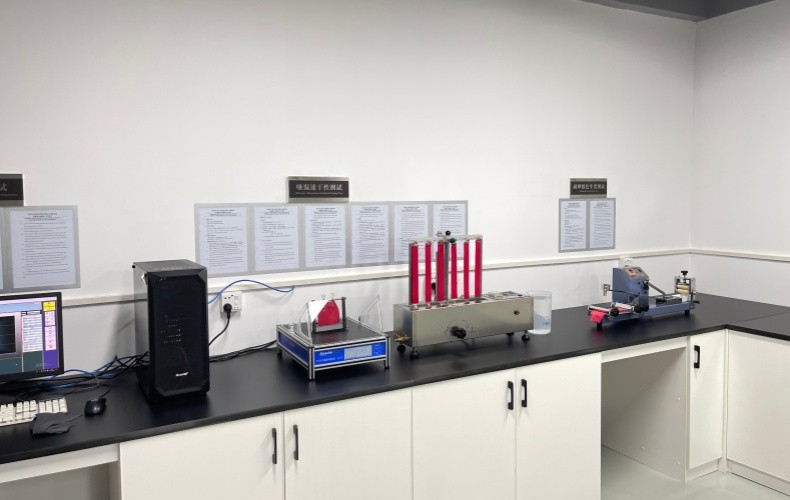
The small components on a hoodie often have harder minimums than the fabric does. Main labels and care labels are ordered by the piece, and a short run costs so much per unit that the usual arrangement is to produce a thousand or more and hold the remainder for your reorders. Drawcords come on spools and aglets in bags, each with a pack minimum. Rib has to be dyed to match the body fabric, so it inherits the same dye lot problem. Embroidery needs a tape and printing needs screens, and both are one-time charges completely unrelated to piece count. The result is a very common situation: the garment itself can be scheduled at 100 pieces, but your custom main label has to be made in a run of a thousand. Either you pay for that up front and hold the balance, or it gets amortised into the unit price of those 100 pieces — and that is a large part of what shows up as the "small run surcharge."
The practical advice is simple: ask the factory to list trims and custom items as their own line group, with the minimum, the unit cost and what happens to the leftover. A factory willing to write it down tends to add fewer charges later. A factory that waves it away with "all flexible" tends to produce new items one at a time after the sample is approved. It is the same discipline we described for sampling quotes, where we broke down what a development fee actually buys you in our outerwear sampling cost guide; the method transfers directly.
The Line: Changeovers Are the Hidden Gate
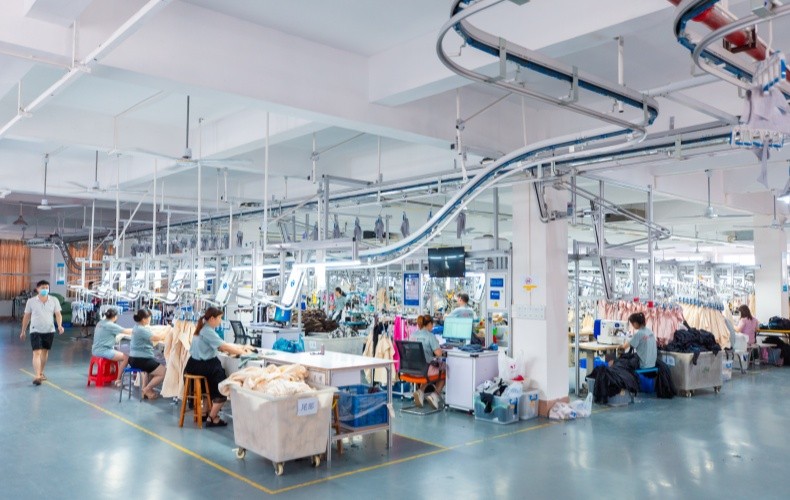
Fabric and trims are one-time costs. The sewing line is a time cost. Moving a hoodie line from the previous style to yours means changing stitch length, presser feet, thread color, flatlock tension, running a first piece and getting that first piece approved. Call it several hours of line time. If your order is eight pieces per SKU, the line spends almost as long switching as it does sewing, which is exactly why factories quote conservatively on orders where the total looks fine but the SKUs are fragmented.
Cutting works the same way. Marker efficiency moves with the size mix: sizes that cluster close together lay out tightly and waste less fabric, while a run spanning XS and XXL at the same time leaves more offcuts, raises fabric consumption per garment, and pushes cost up. Across our two facilities in Guangxi and Dongguan we group similar orders together, scheduling jobs that share fabric and color families back to back, because that is where changeover cost is lowest. It is also why agreeing to a slightly longer lead time can sometimes buy you a better price: it gives the planner room to slot you into a smoother position in the schedule.
Processes: Printing, Embroidery and Washing Run in Batches
Every decoration process on a hoodie carries its own batch logic. Screen printing needs screens cut and ink mixed, per color per screen. Embroidery needs a tape digitised, priced by stitch count, plus thread changes. Garment dyeing, enzyme washes and stone washes run by the vat, tens to a hundred-plus pieces at a time, so a small quantity either shares a vat or pays for one on its own. What these have in common is that their cost sits mostly in preparation rather than in production, which is why unit price climbs sharply at low volumes. If your first run is 100 pieces and you also want three-color printing, embroidery and a wash, the quote will not be pretty, and that is not profiteering — it is three separate setups.
The pragmatic move is to subtract on the first run: get the fit and the fabric proven, keep only the one process that carries your differentiation, and add the rest at reorder. Once you know the style actually sells, the reorder spreads those setup costs over more units and the price gets friendlier. If you want the full development sequence from drawing to first sample, including what has to be signed off at each gate, we laid it out in our five-step OEM/ODM playbook.
Six Factors, Side by Side
Here is everything above in one table. On the left, the factor that moves the minimum. In the middle, why it pushes the minimum up. On the right, whether you can route around it and what that costs you.
| Factor | Why it raises the minimum | Can you route around it, and at what cost |
|---|---|---|
| Fabric color | A custom color has to reach the dye lot minimum; below that you pay a premium or share a vat | Yes: switch to a stock color. Cost: less freedom in your palette |
| Fabric weight and construction | A non-standard weight has to be knitted to order, and greige minimums apply | Partly: choose a weight inside the stock range. Cost: fewer hand-feel options |
| Number of colors | Each color needs its own dye lot, its own scheduling and its own shade approval | Yes: launch one color, hold the rest for reorder. Cost: a narrower first drop |
| Number of sizes | Fragmented sizes lower marker efficiency and add size changeovers | Yes: consolidate to S/M/L. Cost: slightly narrower size coverage |
| Trims and custom items | Labels, cords, tips and rib each carry a minimum; embroidery and print need setups | Yes: use stock trims on the first run, customise at reorder. Cost: less brand presence early |
| Decoration and washing | Screens, embroidery tapes and wash vats are all charged per setup | Yes: keep one core process on the first run. Cost: the design reads simpler |
Three Ways to Split the Same 100 Pieces
The same 100 pieces can land very differently on cost depending on the split. The comparison below is not a price list; it is a way to see where the money actually goes.
| Split | Structure | Cost and lead time behaviour |
|---|---|---|
| Cheapest | 1 color x 3 sizes (S/M/L), stock fabric in a stock color | One dye lot, one marker, no thread changes. Lowest unit price, shortest lead time, easiest to match on reorder |
| Middle | 2 colors x 4 sizes (S–XL), stock fabric in stock colors | Two dye lots, two production passes. Roughly ten percent above the cheapest split, about a week more lead time |
| Costliest | 3 colors x 4 sizes = 12 SKUs, including one custom color plus print and embroidery | Three dye lots including one custom vat, two setup charges. Unit price clearly higher, longest lead time, reorder needs fresh colour matching |
Once this table makes sense, you can see why one factory quotes a 100-piece minimum and another quotes 300: they are assuming different splits. The lower quote usually assumes stock colors and one or two colorways; ask for three colors with custom trims and it will come back with extras. So fix the split before you shop it around, and make every factory quote against the same breakdown. Only then are the numbers comparable.
Practical note: put "number of colors x number of sizes x quantity per size" in your very first enquiry email. Until those three numbers are fixed, every quote you receive is incomparable, because each factory is quietly assuming a different split.
Five Legitimate Ways to Lower the Minimum
One thing deserves its own sentence: do not push the minimum down by accepting a fabric source nobody can explain. That is exactly how the brand in the pitfall case ended up with "300 pieces in five colors": the first run looked effortless and the reorder collapsed. For a growing brand, a supply chain that reproduces reliably on the third and fourth run is worth far more than ten percent off the first one.
What to Ask Before You Place the Order
Common Questions
Can a 100-piece minimum go any lower?
Technically yes, but it depends on the split. With stock colors, one colorway and three sizes, the scheduling threshold really is low. Below a certain point the fixed costs cannot be spread, the unit price climbs noticeably, and the fabric source for reorders becomes hard to guarantee. Our view: treat the first run as the batch that proves the fit and the fabric, and save the volume for the reorder.
Why do more colors push up both the minimum and the unit price?
Because every color needs its own dye lot, its own scheduling, its own shade approval and its own inspection coverage. Three colors means dyeing, cutting, thread changes and quality checks roughly triple, while the piece count per SKU falls, so fixed costs have less to spread across. Holding the second and third colorway for the reorder is the most reliable way to control first-run cost.
How much does custom fabric change the minimum compared with stock fabric?
A great deal. A stock fabric in a stock color can share a vat with other orders, which means a lower minimum, a shorter lead time and a reorder that can be matched. A custom fabric has to be knitted and dyed to order, with greige and dye minimums applied to it, and the surplus either sits as your reserve or lands in the price. If the color does not carry real differentiation, stock is usually the better first-run choice.
How is a small-run surcharge actually calculated?
Mainly from three places: the unused capacity of a dye vat that did not reach its minimum, one-time setup costs for screens and tapes spread across few pieces, and line changeover time. Ask the factory to separate those three and you can judge whether the surcharge is fair. A quote that just says "small runs priced separately" tends to keep producing new charges.
Is the reorder minimum lower than the first order?
Usually more flexible, yes. The pattern, the tech pack, the screens and the embroidery tape already exist, so development costs are not charged again, and if the first run included retained samples and retained dye lots, the reorder can lock the same fabric batch and shade with controllable variation. That is why launching to prove and scaling on reorder beats betting big on the first drop.
About Us
We are Eation Outerwear, a manufacturer with our own production, running one facility in Guangxi and one in Dongguan, about 20,000 square metres in total and roughly 500,000 pieces a month, doing OEM and ODM since 2014 and holding BSCI, GRS, ISO9001 and OEKO-TEX certification. Our hoodie line covers French terry and brushed fleece from about 280 to 500 GSM in both stock and custom specifications, with a 100-piece minimum counted on total order quantity, 7–10 days for sampling and 25–35 days for bulk. We keep retained samples and retained dye lots on stock fabrics, reorders draw on the same batch where possible, and inspection runs to an AQL 1.5 eight-step process that includes shade and weight checks. Two facilities matter for scheduling: when one is tight we can move work across, so your order is not queued behind a line. If you want the full picture of how a custom hoodie moves from specification to production, start with custom hoodie manufacturing 101, and if this is your first technical file, our guide to tech packs for low-minimum hoodies can be filled in as you read it.