How to Choose a Hoodie Manufacturer: A Sourcing Checklist for Emerging, Growing and Established Brands
How to Choose a Hoodie Manufacturer: A Sourcing Checklist for Emerging, Growing and Established Brands
Choosing a hoodie manufacturer is not about who quotes the lowest price — it is about whether six things hold true at the same time: knitting expertise, sampling capability, flexibility on small runs, quality control, compliance certifications, and shipping terms. Emerging and growing brands are the easiest to trap with "low unit price" or "low MOQ" bait while missing the production capacity behind it (established brands often over-focus on price alone and miss the same thing). At our Guangxi and Dongguan plants we set the hoodie MOQ at 100 pieces per style, backed by flexible scheduling rather than a cut-down factory. This article breaks the screening logic into a checklist you can use to read a factory clearly.
- 01A Real Pitfall: A Season Derailed by an "All-Capability" Mega-Factory
- 02Gate 1: Does This Factory Specialize in Knit Hoodies
- 03Gate 2: Sampling Capability (Pattern Room + 7–10 Days + Tech Pack)
- 04Gate 3: Flexible Scheduling for 100-Piece Runs
- 05Gate 4: AQL 1.5 + 8-Step Quality Control
- 06Gate 5: Compliance Certifications Are Not Decorations
- 07Gate 6: FOB Shenzhen and Lead Time
- 08Three Types of Suppliers, Side by Side
- 09Lock Your Hoodie Factory in 5 Steps
- 10Common Questions
A DTC streetwear brand had built hoodies into its hero category and this year wanted to move from "find a contractor" to "find a long-term partner" — both to bring the cost of existing styles down and to co-develop the next season. The two lines a brand like this repeats most are "send me a quote" and "what is your MOQ." But what decides whether you are still working together a year later is the six gates below. Start with a real lesson we have seen on the floor.
A Real Pitfall: A Season Derailed by an "All-Capability" Mega-Factory
An emerging DTC streetwear brand wanted to launch a heavyweight hoodie line. They found a comprehensive factory tagged "we make everything," quoting 8% below a specialist with a friendly MOQ. Before ordering, the supplier promised "we make hoodies every day." When bulk hit the warehouse, three problems exploded at once: first, the fleece weight was inflated — the spec said 380GSM but measured only 322GSM, and the whole batch sagged after two washes; second, the drawcord and pocket positions drifted nearly two centimeters from the confirmed sample, so the fit went sloppy; third, within the same batch the left and right cuff ribs showed visible color variation.
When the brand pushed back, the mega-factory explained "hoodies are not our main line — that batch was slotted in between other work, and QC followed our general garment standard, not a separate knitting spec." That season they not only ate returns and lost money, they missed the launch window, and regular customers moved on to competitors. The problem was not "mega-factories are unreliable" — it was that this factory treated hoodies as a side line, with no dedicated knitting line and no knitting quality control. Lesson one in picking a factory: tell apart "can take the order" from "specializes in it."
A factory that "makes everything" usually means it excels at nothing. For a category like hoodies that lives or dies on fabric and fit, pick a factory that has knitting down cold over a generalist that will use your hero style as practice.
Gate 1: Does This Factory Specialize in Knit Hoodies
Hoodies look simple but are among the trickiest knits to get right. They demand three things: stability of the fabric construction, consistency of the weight, and fidelity of the fit. A factory that mainly runs woven shirts or down jackets and takes hoodies on the side fails far more often than one that runs knits year-round. Judge specialization by four hard indicators:
An independent knitting line
A hoodie specialist splits cutting, sewing, printing, and finishing into knitting-specific lines rather than mixing them with woven production. The clearest side effect of mixed lines is "knit fabric distorted by woven工艺" — stretched cuffs, curled hems, problems that are almost impossible to rework once the goods are in bulk.
A ready-made pattern library
Our plant keeps 12 base pattern libraries, from dropped-shoulder hooded to set-shoulder non-hooded. When a brand wants to modify a silhouette, pulling from the library is far cheaper and faster than developing from zero. If a factory develops from scratch every single time, it has no knitting depth — every order quietly re-pays tuition.
Can it explain fabric construction
You ask "what is the difference between French terry and brushed-back fleece," and if they can tell you terry is "flat face, looped back" while fleece is "raised then brushed," and which weight and season each suits — that is real knowledge; if they only say "about the same, you pick," pass. We cover the concrete differences in our French terry vs brushed fleece manufacturing guide if you want the detail.
Knitting-specific QC nodes
Knit fabric fears lot-to-lot shade variation (same-dye-lot color drift) and shrinkage drift. A specialist keeps a shade card at intake and reverse-calculates shrinkage before cutting. Comprehensive factories often skip these because their inspection flow was built for wovens.
Gate 2: Sampling Capability (Pattern Room + 7–10 Days + Tech Pack Absorption)
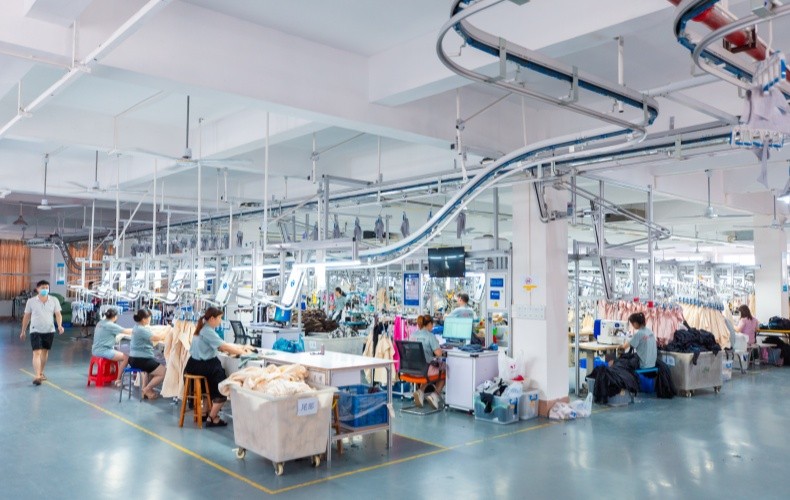
Sampling is the stress test before any partnership. One sample reveals the factory's pattern-room strength, communication speed, and process honesty. Three checkpoints matter:
An independent pattern room
A factory without a pattern room outsources sampling — 20 days for a first sample is normal, and each revision waits another 20. We keep an in-house pattern room; standard hoodie sampling returns a first sample in 7–10 days, with revisions turned inside the pool, so your development calendar never becomes a bottomless pit. Pattern-room strength directly decides whether your next season launches on time.
Can it absorb your tech pack
Emerging and growing brands with a real product plan now know to build a tech pack: size spec, grading rules, fabric construction, trim item numbers, process notes. If the factory cannot read your tech pack and asks you to describe "just make it like that," it lacks engineering-based order intake. We wrote a low-MOQ hoodie tech pack guide you can use to check whether your own pack is硬 enough.
Sample-to-bulk consistency
The hardest red line: the process used on the sample must be the process used in bulk. Some factories hand-finish the sample to fool you, then the bulk line exposes it. We insist sample and bulk share the same line, same process, same QC nodes — the sample is the sealed reference for bulk. When auditing a factory, just ask "are sample and bulk on the same line and same QC?" Hesitation is the signal.
Audit cheat-sheet: Ask the factory for a photo of a hoodie bulk line currently in production plus the matching sample photo, and eyeball whether cuffs, hems, and drawcord handling line up. If they dare send and it matches, they are basically reliable; if they hedge and only send retouched sample shots, be careful.
Gate 3: Flexible Scheduling for 100-Piece Small Runs
For emerging and growing brands still in the trial phase, the most valuable thing about an MOQ is not "pay less" — it is "risk less." Prove a new category at 100 pieces, then reorder 1,000, far safer on cash flow than betting 500 pieces on a hit from the start. But whether 100 pieces can be taken on stably comes down to the factory's scheduling logic:
Traditional mega-factories spread changeover cost across thousands of units; small orders do not close, so either the unit price doubles or they refuse. Our approach is flexible scheduling — two plants in Guangxi and Dongguan total 20,000㎡ with 500,000 pieces a month capacity, lines split by category, and a "small-order buffer slot" reserved inside each category's pool. A 100-piece run does not monopolize a line; it slots between bulk orders of the same fabric, sharing one machine setup, amortizing changeover to near zero. That is why 100 pieces gets close to bulk pricing instead of a 2× premium.
The boundary must also be clear: at 100 pieces we can do custom fabric composition, custom weight, custom print, and pattern tweaks — but not an entirely new composite process developed from scratch, which is still priced as a development order. That is the honest line, and not every factory will tell you where it sits. For a brand just expanding its hoodie line, that is exactly the point: every dollar buys real capacity, not a pitch.
Gate 4: AQL 1.5 + 8-Step Quality Control
The hard part of hoodie QC is "hidden defects": pilling after wash, seam splitting, print flaking, lot-shade bleed — none visible at a glance, all exposed after two wears or one wash. A specialist must catch these with knitting-specific standards.
We run AQL 1.5 sampling plus an 8-step full inspection: intake inspection (shade card, shrinkage reverse-calc) › cutting inspection (check align) › sewing patrol (first piece + roving) › print/embroidery inspection (adhesion, placement) › finishing inspection (distortion, glare) › finished-product sampling (AQL 1.5 table) › packing inspection (tags, folding) › pre-shipment final review. Any step that fails does not pass to the next. When auditing, ask directly "what AQL level do you use for knits, and which standard is your sampling plan based on?" One that answers AQL 1.5 and can list the steps is the one with a real system.
Gate 5: Compliance Certifications Are Not Decorations
Emerging and growing brands will eventually enter EU and US channels, where buyers and platforms check certifications (established brands need them as routine). Certifications are not plaques on a wall — they are proof of a supply-chain baseline. Our plant holds four: BSCI (Grade B) social responsibility, GRS Global Recycled Standard, ISO 9001 quality system, and OEKO-TEX Standard 100 hazardous-substance testing. For the buyer value of each, we wrote an OEKO-TEX and GRS certification guide (note: this post is planned for later publication); here we only make one point clear —
When screening a factory, do not just ask "do you have certificates" — ask "do the certificates cover the production unit that makes this style?" Some factories hold group-level certificates that may not cover a specific workshop. Require the certificate number valid for your order, in date — that is real due diligence, not a checkbox.
Gate 6: FOB Shenzhen and Lead Time
Finally, delivery. Emerging and growing brands fear "goods are ready but stuck at the port" (established brands care more about locked lead times). We use FOB Shenzhen (shipment from Shenzhen port); both plants ship via Shenzhen, with stable logistics paths and easy consolidation. On lead time, knit and hoodie bulk runs 25–35 days, technical styles with composite processes 35–45 days, and sampling takes 7–10 days. These numbers are not marketing talk — they are nodes the scheduling system can lock.
We suggest writing "what happens on a lead-time breach" into the contract too — only a factory confident in its capacity will commit explicit penalty clauses. One that says "don't worry, definitely on time" but won't put it in writing, be careful.
Three Types of Suppliers, Side by Side
Compress the six gates above into one table; the real gap between a hoodie specialist, a comprehensive mega-factory, and a husband-and-wife workshop is clear at a glance:
| Factor | Hoodie Specialist | Comprehensive Mega-Factory | Small Workshop |
|---|---|---|---|
| Knitting line | Independent, dedicated lines, year-round | Mixed lines, hoodies often slotted in | Mostly manual, no line |
| Sampling cycle | 7–10 days, in-house room | 15–25 days, often outsourced | Depends on master's schedule, very unstable |
| Small-run flexibility (MOQ) | 100/style, flexible scheduling | 500–1000 minimum, high small-order premium | Low MOQ but low capacity ceiling |
| QC system | AQL 1.5 + 8-step knit-specific | General garment QC, knits easily missed | Owner eyeballs, no standard |
| Certifications | BSCI/GRS/ISO/OEKO-TEX | Usually yes, but may not cover the workshop | Basically none |
| Shipping & lead time | FOB Shenzhen, lockable nodes | FOB major port, but long queue | Often you find your own freight forwarder |
Lock Your Hoodie Factory in 5 Steps
Turn the six gates above into executable actions; keep a record at each step:
Common Questions
Is a 100-piece MOQ only relabeling stock styles?
No. At the 100-piece tier we can do custom fabric composition, custom weight, custom print, and pattern tweaks — backed by 12 base pattern libraries and flexible scheduling, not stock blank labeling. A fully from-scratch new composite process is still priced as a development order; we state this up front, no hiding.
How do I tell if a factory truly has a pattern room or outsources sampling?
Ask the first-sample cycle directly. An in-house room returns a first hoodie sample in 7–10 days; an outsourced factory often takes 20-plus days and requeues on every revision. Also ask for a photo of a hoodie bulk line in production plus the matching sample, and eyeball them — one that dares send and lines up is basically reliable.
Is AQL 1.5 actually strict?
AQL 1.5 is a fairly strict consumer-goods sampling level, meaning the allowed defect ceiling in a batch is low, suited to body-close hoodies sensitive to hidden defects. Combined with our 8-step full inspection, it catches pilling, seam splitting, and lot-shade bleed before shipment. You can require the factory to provide an inspection record sampled by AQL 1.5.
A mega-factory quotes 8% lower — isn't that better value?
Not necessarily. Low unit price often comes from treating hoodies as slotted-in work and skipping knitting-specific QC; the hidden rework and return costs ultimately land on you. The earlier case derailed by an "all-capability" mega-factory saved 8% on the surface but lost a whole season. For a hero category, a specialist's full-cycle cost is usually lower.
About Us (OEM·ODM Outerwear Partner for Emerging, Growing and Established Brands)
We have focused on outer-layer manufacturing since 2014. Our Guangxi and Dongguan plants total 20,000㎡ with 500,000 pieces monthly capacity, holding BSCI (Grade B), GRS, ISO 9001, and OEKO-TEX Standard 100 certifications, running AQL 1.5 plus an 8-step QC process, shipping FOB Shenzhen. The hoodie category MOQ is 100 pieces per style, backed by flexible scheduling rather than a cut-down factory. To see our development process and real capacity, read our capsule outerwear line build guide.
Ready to pick your hoodie manufacturer? Send us your tech pack or the style you want to make. We return a first sample in 7–10 days and give you a transparent quote at a flexible 100-pieces-per-style MOQ — get a hoodie sampling and quote plan built for your brand.