Tech Pack for Low-MOQ Hoodies: A Manufacturer's Guide
Why a Smaller MOQ Makes a Precise Tech Pack Matter More
A tech pack is not a drawing — it is a contract written in millimeters, grams per square meter, and color codes. The more complete it is, the more accurate the quote, the faster the sample, and the closer the bulk to the sealed sample in your hand. A 100-piece low-MOQ order can least afford a vague tech pack — rework cost spreads to double-digit percentages on a small run, but only a fraction on bulk. This piece gives you a five-module checklist forged in a garment manufacturer's pattern room: construction, fabric tolerances, locked color codes, trim part numbers, and labeling & packing, plus a self-audit list you can copy directly.
- 01Why a smaller MOQ makes a precise tech pack matter more
- 02A real pitfall: "just make it like this" cost three weeks
- 03The five modules that prevent rework
- 04Tech pack self-audit checklist: tick off five modules
- 05The two fields most often skipped: weight tolerance & seam map
- 06One tech pack, two fates: workshop vs scaled factory
- 07How a tech pack compresses sampling into 7–10 days
- 085 steps for a growing brand to build a tech pack
- 09Common questions
A growing streetwear brand with an Americana aesthetic sent a beautiful design for a winter heavyweight hoodie series to three factories for quotes. The quotes came back lower and lower, and they finally chose the cheapest one for a 100-piece production run. When the boxes arrived: the hood shape had collapsed, the fabric weighed 40 grams less than the sealed sample, and the pocket sat two centimeters off. The cost of the rework was more than triple the price difference they had saved. The problem was not the factory's craft — it was the one-page tech pack that held only a rendering. The factory did not guess wrong; it simply filled the invisible blanks with the fastest, cheapest option available.
Run the numbers and you will see why a small run is actually more exposed. Suppose those 100 hoodies were worth about 3,000 US dollars. Once a deviation is found and the whole batch is remade, plus round-trip freight, re-ordered fabric, and idle time, the real loss often climbs past 1,000 dollars — 30% to 50% of the order value. The same deviation on a 10,000-piece bulk order usually costs only 3% to 5%, because the fixed cost is diluted. So the smaller the MOQ, the higher the leverage of the tech pack as "insurance": three hours of writing clear fields blocks roughly a third of the order's potential loss.
The logic below comes from the pattern room and the sewing floor: what kind of tech pack lets a 100-piece small run achieve bulk-level certainty, which fields inevitably fail once skipped, and why the very same spec sheet ends up on two completely different curves depending on the type of factory it reaches.
A Real Pitfall: "Just Make It Like This" Cost Three Weeks
Let us start with a generalized pitfall case. A rising brand brought a social-media-style rendering and the line "just make it like this" to a contract manufacturer, ordering 100 heavyweight zip-up hoodies. The image said only five words: "400gsm heavyweight." No weight tolerance. No note on whether it was loopback or brushed fleece. No garment-wash process specified. The factory, following its own routine, chose 380gsm ordinary loopback. When the garments arrived, the thick, structured hand-feel was entirely absent — the client wanted a heavyweight that could "stand up," and got a soft everyday piece instead.
The more expensive part came later. The client demanded rework, but the fabric had already been cut to the wrongly-decided spec, so the entire batch had to be scrapped and remade. After two rounds, the brand missed its entire fall-winter launch window. A post-mortem was clear: if the original tech pack had stated "400–420gsm, double-yarn loopback, garment-washed, weight tolerance ±5%," this accident would never have happened. Three lines of text bought back three weeks of lead time and a whole season.
Unpack the accident and it is really a stack of losses accumulated by omission, each layer more expensive than the last: the first layer is the sealed-sample scrap, a few hundred dollars of prototype cost down the drain; the second layer is the entire bulk order, fabric, cutting, and sewing all redone, losing the full order value; the third layer is opportunity cost — the cash flow and exposure that batch could have returned are gone forever. The place where the tech pack was sloppy is exactly where these three layers of loss began to compound.
A tech pack is not homework handed to the factory; it is insurance on your own order. Writing every field clearly is, at its core, exchanging "the factory's guess" for "your decision" field by field. A guess scraps a few hundred dollars of sample cost at the prototype stage, but scraps the entire batch value at the bulk stage.
A vague tech pack saves three days of documentation and costs three weeks of bulk lead time. Every unclear word between you and the factory eventually becomes an invoice.
The Five Modules That Prevent Rework
A tech pack that lets a garment manufacturer quote once and seal a sample in one round contains at least five modules, and the order matters — earlier decisions constrain later ones. Below, each module is broken down to a "fill-it-in-now" level of detail.
1. Construction
Front and back flat sketches, the seam type at every component (lockstitch, coverstitch, four-thread overlock), and seam allowance direction. Do not expect a hoodie manufacturer to "get the hood from the picture" — the hood shape is a structural problem decided by three seams plus one center-hood gusset; it must be drawn and marked, not intuited.
The most important things to pin down in the construction module are the size chart and grade rule: chest, body length, sleeve length, shoulder, hood height, and rib height at the hem, each with a tolerance (typically ±1cm). The grade rule states how much each size jumps — streetwear drop-shoulder styles often grade in 5cm steps, shoulder width +1.5cm per size, body length +2cm per size. Write this clearly so the factory does not have to re-derive it, and so different sizes do not drift in silhouette. The kangaroo pocket placement (distance from shoulder seam, pocket width, tilt angle) must also land on coordinates, not "normal position."
2. Fabric (with tolerance)
Do not write "380gsm cotton" — write "380–400gsm, 100% combed cotton, French terry loopback construction." The tolerance is the line that prevents the delivery from becoming a different cloth entirely; we will cover why it is most often skipped later.
The fabric module must also capture "construction" and "wash," because these two words decide the essence of the hand-feel. At the same weight, French terry loopback has a flat face and looped back, leaning crisp; brushed-back fleece shears and brushes the back into nap, leaning soft and warmer, but with different weight distribution. In composition, "100% cotton" and "CVC 60/40 (cotton-poly)" wear and pill completely differently and must be specified. The wash process — garment enzyme wash, stone wash, or enzyme-abrasion for a worn look — directly decides final weight and hand-feel. Omit this and the factory delivers grey goods unwashed, and the piece comes in far lighter.
3. Color (locked codes)
Pantone TCX or CIELAB values, not "that beige from last time." Screens shift, memory drifts, a color code does not. For color-blocked or garment-washed styles, also state the post-wash target color and attach a reference swatch.
One more line in the color module prevents a rework: lot-shade control. Different dye lots of the same code can drift about ±0.5, so the tech pack must state "lot shade within half a grade on the same bulk run, matched against the sealed-sample swatch." Color-blocked styles (say a contrast center-hood gusset) need separate main and accent codes, with the blocking boundary noted on which seam. Garment-washed styles must give the "post-wash target color," because pre-wash and post-wash can differ by two or three codes; give only the pre-wash code and the factory will deliver something noticeably darker.
4. Trims (with part numbers)
Drawcord thickness and tips, rib composition and weight, zipper brand and model, snap button face diameter — give supplier and part number. "A nice-quality zipper" is a footnote for rework; a part number is a spec.
Trims are the easiest place to be carried by description yet the easiest to fail. The zipper needs brand and model (e.g. a specific series #5 closed-end zipper from a named maker) — different brands differ in tooth width and pull feel. Rib needs its knit (1×1 or 2×2), composition, and weight, or the hem and cuffs go slack. Drawcord needs diameter (typically 5mm) and tip treatment (metal crimp or plastic toggle). Snap buttons need face diameter (10–15mm) and bottom stud spec. Eyelets need inner diameter. Once these part numbers are exact, a reorder pulls the same supplier and same lot, and consistency is actually guaranteed.
5. Labeling & Packing
Main label, care label, size label — position and technique (woven vs printed), and the single-unit packing method (OPP bag or naked). A meaningful share of retail returns come from the label and packing stage, not the silhouette — and this is precisely the part most often omitted.
The labeling module must also handle compliance, which is a hard gate for entering EU and US markets, not decoration. The main label needs fiber composition, country of origin, and care symbols. The care label, in multilingual markets (the EU, for instance), must state fiber composition and care in the local language. Children's apparel exported to the US must meet 16 CFR flammability and tracking-label requirements; goods to the EU must satisfy REACH limits on hazardous chemicals. The hangtag needs barcode, price sticker, and brand info positions spelled out. Write these compliance items into the tech pack so the factory sets the labels before sewing, instead of discovering at bulk that the labels are non-compliant and the whole batch is stuck at customs or returned.
Tech Pack Self-Audit Checklist: Tick Off Five Modules
Turn the five modules above into a checkable list and run through it before sending. We have seen too many orders "fail by one line" — this list exists to block those single lines. Only when every item is filled is the tech pack qualified.
| Module | Required items | Most common consequence of omission |
|---|---|---|
| Construction | Front/back sketches, size chart with tolerance, grade rule, seam allowance & stitch type, pocket placement coordinates | Hood distortion, silhouette drift across sizes, crooked pocket |
| Fabric | Weight with tolerance, composition, construction (loopback/brushed), wash process, measured shrinkage | Softer hand-feel, under-weight delivery, shrunk codes after wash |
| Color | Pantone/CIELAB code, lot-shade control, color-block boundary, post-wash target | Batch shading, misaligned blocking, darker after wash |
| Trims | Zipper brand/model, rib construction & weight, drawcord spec, snap face diameter, eyelet inner diameter | Trim feel mismatch, unmatched reorders, slackness |
| Label & Pack | Main/care/size label technique & position, compliance, single-unit packing | Non-compliant return, retail returns, packing chaos |
The value of this list is not "write more" but "leave no blank." Any cell filled with "standard," "about right," or "you decide" equals handing that item's decision back to the factory — and an unconstrained factory will always pick the fastest, cheapest option for itself, not necessarily the one you want. The pass line is simple: five modules, fifteen required items, none empty.
The Two Fields Most Often Skipped: Weight Tolerance & Seam Map
If you are allowed to add only two fields, add these. The first is fabric weight tolerance. Without it, "380gsm" can legally arrive at 340gsm — under the common ±5% industry practice, that still "meets spec," and your heavyweight hand-feel is gone. Put it in the tech pack so that at inspection, weighing a sample against tolerance gives you something to negotiate with; skip it and you have voluntarily waived that right.
The second is the seam map: which seams use lockstitch, which use coverstitch, and what stitch density (typically 10–12 stitches per 3cm). These are things the consumer can feel the moment they pick up the garment, and exactly where an unconstrained factory reverts to low-cost habits. The AQL 1.5 inspection standard catches obvious defects like holes and skipped stitches, but it does not catch "matches the sample yet is not what you wanted" seams — that must be nailed down on paper first.
A field equally easy to miss is shrinkage. Fabric shrinkage must be measured at the sampling stage, and the finished-size chart calculated backward from it, or one wash turns your S into an XS. Example: measured shrinkage is 4%, and your target finished chest is 110cm. Then the pattern chest should be set to 110 ÷ (1 − 0.04) ≈ 114.6cm; the greige cut to that dimension and washed settles back to your 110. A mature manufacturer will proactively run a shrinkage test at sampling, but the correct move is to write it into the tech pack so it becomes an obligation, not a courtesy.
The more complete the tech pack, the more sampling becomes one verification rather than a negotiation. Verification is checking the sample against the standard; negotiation is inventing the standard on the spot.
One Tech Pack, Two Fates: Workshop vs Scaled Factory
The same qualified tech pack, placed with different types of factories, walks two completely different curves. The table below is the real gap we have seen:
| Dimension | Small workshop without a pattern room | Scaled line (dual-factory system) |
|---|---|---|
| Tech pack reading | Misses gaps, fills blanks by habit | Dedicated check, proactively asks on gaps |
| Sampling lead | 15–30 days, pattern room often outsourced | 7–10 days, in-house pattern room |
| Tolerance control | No tolerance concept, by feel | ±5% internal control, swatch & lot kept |
| Bulk consistency | Shades and weights drift by batch | Lot shade controlled, reorders matched to swatch |
| QC loop | One visual pass | AQL 1.5 plus 8-step QC, report issued |
| Lead-time certainty | Spare-order driven, uncertain | 25–35 days, locked into the production pool |
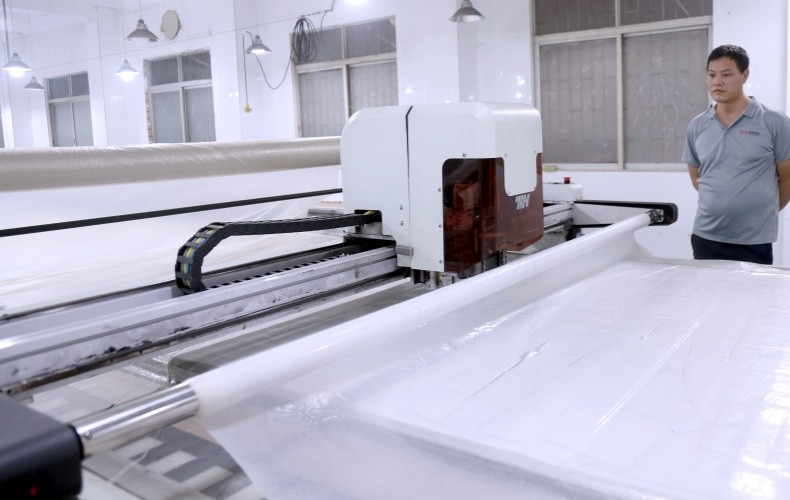
The point is not "big factory is always better," but whose hands the tech pack is taken seriously in. A factory with its own pattern room, given a complete spec, produces the paper pattern the same day and pulls prepared fabric by the stated spec without discounting; if something is missing it comes back to you, instead of filling it for you. A small workshop often lacks both the capability and the habit, and even the most complete tech pack can get "saved in half" once it reaches them. So when choosing a factory, rather than only comparing unit price, look first at whether they have a pattern room and whether they proactively check the tech pack — that is the watershed of whether a small run achieves certainty.
How a Tech Pack Compresses Sampling Into 7–10 Days
The ceiling of sampling lead time was never the sewing speed, but the number of information round-trips. Miss one field in the tech pack and the factory stops to ask you once; reply a day late and the lead time slips a day. A tech pack with all five modules complete compresses the confirmation round-trips to within one cycle — and that is exactly the premise that lets us hit a 7–10 day first sample: the pattern room issues the paper pattern the day it receives the spec, and the fabric is pulled and prepared directly to the written spec, no discounting.
Break the 7–10 days open and every step depends on the tech pack's completeness: day 1 pattern and grading, day 2 fabric pull (only possible if specs are clear, otherwise waiting on confirmation), days 3–5 sewing and pressing, day 6 garment wash (only correct if the process is written), days 7–8 inspection and photography, days 9–10 dispatch. Any link that stops to wait for an answer because "it was not written clearly" pushes the whole line back. Conversely, when the tech pack is complete, these ten operations run almost seamlessly.
Bulk is the same logic. A complete tech pack lets four lines — trim procurement, production scheduling, sewing, and QC — start in parallel; a vague order can only run serially, blocked behind the previous link's question. With the same capacity, complete-tech-pack orders commonly lock a 25–35 day lead time and do not consume someone else's window.
5 Steps for a Growing Brand to Build a Tech Pack
- Start from a validated base pattern. Modifying beats developing from scratch by half the time and is far easier to control. A silhouette started from zero every season means every field of the tech pack is a gamble.
- Use a fixed template, not a blank document.Lock the five modules — construction, fabric, color, trims, labeling — and only fill the changing items each season. What is missing becomes visible at a glance, nothing slips.
- Give every fabric spec a tolerance.Weight, composition, construction, shrinkage — all as ranges. A spec without a range is effectively unwritten; at quoting, the factory can only price to the high side.
- Reverse-audit the tech pack during the sampling rounds.Each round of samples in hand, check point by point against the spec sheet and write deviations back into the document. The tech pack is a living document, not a one-shot design draft.
- Attach a revision record on reorders.On a bulk reorder, attach the previous run's deviation log and revision number so the factory executes the new version, not the sales rep's memory.
The easiest of these five steps to skip is the fourth. Many brands treat the tech pack as a one-time document before ordering, lock it into a hard drive after sealing the sample, and still get it wrong on reorders. The correct move is to write each round's measured data (actual weight, measured shrinkage, shade grade) back into the document, so the next order pulls the latest version. The tech pack gets more accurate the more it is used, and the rework rate keeps falling.
Common Questions
I have no designer, only a reference image. Can I still build a tech pack?
Yes. Send the reference image, target weight and hand-feel, and size range to a garment manufacturer with an in-house pattern room; the pattern room converts the reference into flat sketches and a size chart, confirming each item with you point by point. This is exactly the core value of ODM service: the tech pack can be completed for you by the factory, but every field must be signed by you — and only after signing does it become a contract.
How detailed must a tech pack be to count as enough?
The standard is "the factory no longer needs to ask you anything." Five modules complete, fabric with tolerance, color with code, trims with part numbers, labels with position map — that is the pass line. Beyond that enters the spec-card level; parameters like stitch density and seam allowance are usually supplemented by the factory's pattern room per its line standard, and you only need to confirm the key appearance points.
Is it reasonable to send the same tech pack to multiple factories for quotes?
Not only reasonable, but recommended. Sending the same tech pack to two or three manufacturers makes the quoted prices comparable — the only difference left is labor price and capacity, not each party's interpretation. A vague requirement can never surface a real price; what you compare is merely each party's imagination.
How is the spec written in the tech pack actually enforced at bulk?
Through the inspection standard and the swatch loop. We run AQL 1.5 plus an 8-step QC: fabric weight sampled and weighed against tolerance, color matched to the sealed-sample swatch, key dimensions measured per the spec-sheet size chart by code. The tech pack, the sealed-sample swatch, and the inspection report form a closed loop — leave out any one, and the spec sheet is just a wish list.
Do I need to give the factory a 3D garment file?
Not mandatory, but increasingly common. A 3D file (e.g. a pattern exported from apparel CAD) lets the factory see the 3D silhouette before the cutting table, reducing first-sample structural deviation — suitable for complex silhouettes or when you particularly care about appearance. For a regular crewneck hoodie or a basic zip-up, a clear flat sketch plus size chart is already enough; 3D is not required. The rule is simple: the more non-standard the silhouette, the higher the marginal value of 3D.
How do I update the tech pack on reorders without errors?
Bring back the previous run's measured deviations and revision number. Specifically: keep a revision log area at the top of the document stating "version, what changed, on what basis," send the latest version number on the next order, and name it in the email — "please execute per V2, do not use the old version." On the factory side, archive the sealed sample and, on reorder, first match it to the swatch before cutting. Version number plus swatch: the two insurances that let even a small run reorder stably.
About the Production Line
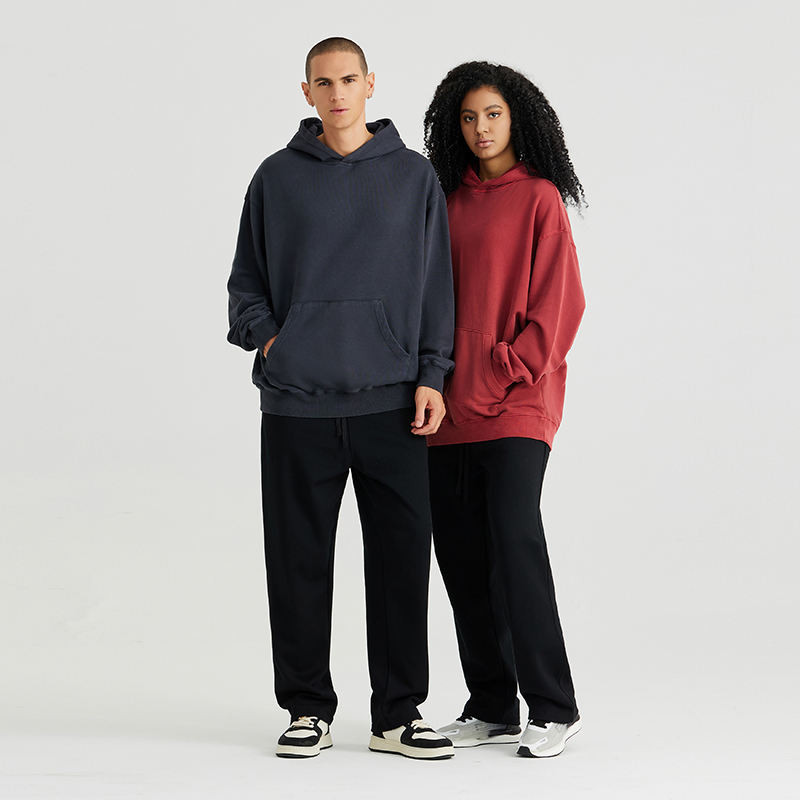
Two factories in Guangxi and Dongguan, totaling 20,000 square meters with a monthly capacity of 500,000 pieces, making streetwear OEM / ODM since 2014 and serving over 1,200 brands. An in-house pattern room handles tech-pack conversion and sampling with a 7–10 day first sample; QC runs AQL 1.5 plus an 8-step process, certified BSCI (Grade B), GRS, ISO 9001, and OEKO-TEX Standard 100. Port of shipment is Shenzhen (FOB Shenzhen); small runs ship by LCL or express sample lines.
Ready to have your next hoodie run executed against a tech pack? Send the rendering or existing tech pack plus fabric preference, and we return a transparent itemized quote and sampling lead time — our in-house pattern room writes construction, weight tolerance, and seams into the sealed sample, so 100 pieces can run on that "contract," and you reorder once the data checks out.