Private Label vs OEM vs ODM: A Clothing Manufacturer's Plain-English Guide
Manufacturer's View: PL / OEM / ODM Is Not a Convenience Spectrum — It Is Who Owns the Fit and the Risk
Private Label, OEM, and ODM are often ranked "low to high effort" as if they were steps on the same ladder. They are not. What they actually decide are two things: who owns the pattern, and who carries the risk. ODM looks fast, but it inherits the full set of problems buried in someone else's ready-made pattern — every unit you sell carries fit defects that were never yours to begin with. We have run OEM / ODM since 2014 from our dual-factory system, taking 100-piece MOQ custom hoodies and light outdoor clothing (outdoor clothing); our steady advice to growing brands is simple: bring your own tech pack and run OEM — that is the defensible path.
- 01Manufacturer's view: the three models decide fit and risk
- 02Factory floor lesson: a brand sunk by an ODM ready-made pattern
- 03How the three models actually differ (in manufacturer's terms)
- 04One table: where the three really diverge
- 05How a growing brand should choose: 4 checks
- 06Common questions from brand owners
A brand just starting out comes to a manufacturer and opens with "do you do ODM? Ideally one-week sampling, I just slap my label on and list it." This is painfully common in the industry. Fast, yes. But the other side of fast is this: that pattern is not yours, and every hidden flaw in it — a skewed shoulder line, a tight armhole, post-wash distortion — becomes yours too. The buyers complaining are complaining about you, not the original design house.
Below, in plain factory-floor language, we break the three models apart: who each one puts the pattern and the risk on, which to choose at which stage, and why we have always been cautious about ODM.
This matters most for growing brands precisely because the cost is delayed. A major brand has redundant budget and a merchandising team — pick the wrong model and it absorbs the hit. A growing brand is often one founder wearing the buyer hat, with thin budget and a narrow window; once you label a flawed pattern, the complaints and returns do not surface until one or two months after launch, by which point the season is gone and the stock is parked. So "choose the model right" is the highest-ROI firewall there is — half an hour reading the three sections below may save you tens of thousands in trial and error.
Factory Floor Lesson: A Brand Sunk by an ODM Ready-Made Pattern
A brand doing vintage-sport styles, wanting quick volume, picked a supplier's ODM ready-made hoodie pattern — skip the patterning, just relabel and launch. It sold for two months. Then the bad reviews came: across the same style, different batches had sleeve lengths off by nearly 1.5cm, and northern buyers said "one sleeve longer than the other." Tracing it back, that ODM pattern had never locked tolerances; every batch drifted with the sewer's feel. The brand wanted to fix it; the supplier said "this is a generic pattern, changing it means re-patterning from scratch" — which meant going right back to OEM sampling from zero. All the "time saved" went back out the door, plus two returned batches.
The essence of this trap is that ODM hands the "pattern ownership" to the supplier, and you only buy the "labeling right." If the pattern is good, you get a bargain; if it has a hidden defect, you absorb it in full. For a growing brand trying to build a name, this is not a shortcut — it is handing your moat to someone else.
How the Three Models Actually Differ (in Manufacturer's Terms)
Private Label / PL: You Buy "Ready Goods + Your Label"
The supplier already has a mature style; you swap the logo, swap the hangtag, maybe change a color, and list it. Pattern and production both sit with the supplier; you barely touch the design. The upside is speed and a low entry bar; the downside is sameness — what you are selling, the shop next door is selling too, and the moment a price war starts, all that is left is a thin margin. Good for testing a style or a clearance channel; useless as a brand moat.
A very common starting rhythm: a brand doing basic hoodies takes a supplier's ready style under PL, relabels, and launches in two weeks to test reaction; once a style breaks out, they move it to OEM and lock the pattern themselves for differentiation. PL handles "fast test," OEM handles "compounding" — each does what it is good at, and it is a steady play for a growing brand.
OEM: You Bring the Tech Pack, the Factory Builds to It
Pattern, fabric, and construction are all defined by you; the factory only produces to your tech pack. The pattern is yours, and so is the risk — but precisely because it is yours, you can lock it, iterate it, and turn it into an asset. The first thing we do on receiving an OEM tech pack is a manufacturability review, turning the vague parts into executable instructions. At a 100-piece MOQ you can already run, and even a small run keeps the pattern in your own hands.
A real example from the floor: a brand doing workwear-style jackets had locked the shoulder line and sleevePitch弧度 very tightly in their own pattern. In our review we noticed that exact curvature would wrinkle on a certain fabric, suggested a stitch-line change, the brand adopted it, and the first sample was clean — three subsequent bulk batches shipped with zero rework. The pattern was in their hands, so the problem got filtered out by their own tech pack at the bud. That is the value OEM leaves on the brand's side: control.
ODM: The Factory Authors the Pattern, You Relabel or Tweak
The factory both designs and produces; you take a ready pattern and relabel, or make a light change. Sounds like the least effort — but the pattern ownership sits with the factory, and that pitfall case above is exactly a brand absorbing an ODM ready-pattern defect in full. ODM is not forbidden; the key is "have you verified, sealed, and tolerance-locked this pattern?" Label it unverified and you are underwriting someone else's pattern.
We have also seen the reverse lesson: a brand took an ODM pattern and labeled it directly; that pattern's hood curvature sat too far back, and buyers said "the hood keeps falling backward." Trace it back and the factory said it was a generic pattern and would not change it alone — the brand either accepted the defect or went back to patterning from scratch. So ODM's saving is at the front end; the price is buying the pattern risk at the back end.
One Table: Where the Three Really Diverge
The same hoodie yields three completely different levels of "control" under the three models. This table does not compare who is cheaper; it compares one thing only: who owns the pattern, who carries the risk, and how many chips you have left in your hand.
| Dimension | Private Label (PL) | OEM | ODM |
|---|---|---|---|
| Pattern ownership | Supplier | Brand (your tech pack) | Factory (ready pattern) |
| Design involvement | Nearly none | End-to-end lead | Light tweaks mostly |
| MOQ bar | Low, often tiny | We start at 100 pcs | Mid, depends on ready stock |
| Risk ownership | Supplier holds pattern risk; you take sales | You hold pattern risk, but controllable | Factory holds pattern risk; you absorb it |
| Differentiation / moat | Weak, easy to copy | Strong, pattern is an asset | Mid, depends on sample sealing |
| Speed to market | Fastest | Depends on sampling (7–10 days) | Fast, but risk deferred |
| Best stage | Test style / channel goods | Build a long-term brand | Urgent speed, willing to verify |
Many suppliers dress ODM up as "one-stop peace of mind." We who make things do not sugarcoat: ODM saves your front-end time, and the price is buying the pattern risk at the back end. The only way to have both peace of mind and no trap is to run an ODM pattern through an OEM verification flow — seal the sample, lock the tolerances, then label it.
How a Growing Brand Should Choose: 4 Checks
1. Do you want a long-term brand? If you want a moat, the pattern must be in your own hands — choose OEM; your tech pack is an asset you can iterate and defend. If you only want to move a wave of channel goods, PL is fastest.
2. Have you verified the pattern? If you must go ODM, first have the factory sample it, you seal it, lock tolerances, confirm that pattern is clean, then relabel. Label it unverified and you are underwriting someone else's defect.
3. Where does your MOQ sit? Our OEM runs from a 100-piece MOQ; even a small run keeps the pattern in your hands, so you do not sacrifice ownership just to clear a low barrier. Low volume is not a reason to choose ODM.
4. Speed or risk — which wins? Rushing a time window and willing to verify, ODM works; building a steady brand and treating the pattern as an asset, OEM is the safer road. We run both under our dual-factory system — the difference is simply where you put the "pattern ownership."
Whichever road you take, what it lands on at the production end is the same system: can the in-house pattern room properly review your tech pack, can the three-stage sampling and golden-sample sealing lock the tolerances, can the fabric lab run pre-shrink and wash tests. With those capabilities, an OEM pattern becomes a real asset; without them, ODM's speed only pushes the risk further down the line. Running OEM / ODM from our dual factories since 2014, what we compete on is exactly this infrastructure that hands the "pattern control" back to the brand.
Common Questions from Brand Owners
Is ODM really off-limits, and when can it be used?
It can be used, but only if "verified." After the factory samples the ODM pattern, you run it through the OEM verification flow: seal the sample, lock tolerances, run pre-shrink and wash — confirm the pattern is clean, then relabel. For a brand rushing a time window and willing to spend that step, ODM is a fast road; skipping verification and labeling directly is the trap.
Does OEM always require a huge minimum order?
Not necessarily. Our OEM runs from a 100-piece MOQ, with an in-house pattern room first sample in 7–10 days; even a small run keeps the pattern in your own hands. A low MOQ does not mean lower standard — it just lets you turn your tech pack into an asset at smaller cost.
Can private label and OEM be mixed?
Common and reasonable. Use PL to quickly test a few styles and see which moves; convert the winner to OEM, lock the pattern yourself, and build differentiation — a very steady rhythm for a growing brand: use someone else's goods to test the water, then turn the winner into your own asset. We handle both.
I chose OEM — do I have to write the tech pack myself, can the factory help?
You set the direction (pattern intent, fabric, construction); on receipt we run a manufacturability review and turn the vague parts into executable factory instructions: size spec with tolerances, fabric composition and GSM, trims, print positions. A one-page table plus a few annotated images is enough for a small team; the key is that you hold the pattern ownership and the factory helps land it.
About the Production Line
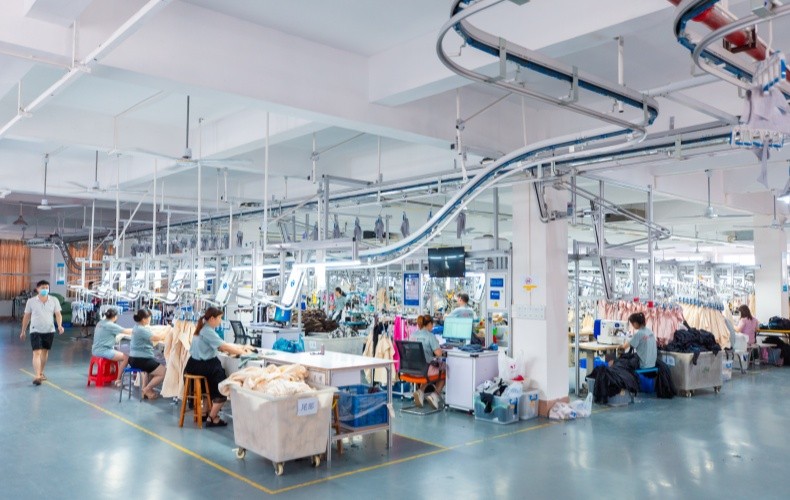
Two factories in Guangxi and Dongguan, 20,000㎡ combined, 500,000 pieces monthly capacity, making streetwear and light outdoor clothing (outdoor clothing) on OEM / ODM terms since 2014, for 1,200+ brands. The in-house pattern room handles tech-pack review, three-stage sampling, and golden-sample sealing; garment QC follows AQL 1.5 plus an 8-step process; certified BSCI (Grade B), GRS, ISO 9001, OEKO-TEX Standard 100. Port of shipment: Shenzhen (FOB Shenzhen).
Have you figured out who owns the pattern? Send us your direction — pattern intent, target fabric, and the differentiation you want — and we return an OEM / ODM path recommendation with a tech-pack review plan: whether the pattern stays in your hands or borrows the factory's, how the risk splits, and 100 pieces can run one version first to feel the hand.