Outdoor Clothing MOQ: A Manufacturer's Guide for Growing Brands
Outdoor Clothing MOQ: A Manufacturer's Guide for Growing Brands
For a growing brand adding an outdoor clothing category, the MOQ is not a wall — it is the volume where custom production stops costing like prototyping. At our Guangxi + Dongguan plants we run a true 100-piece floor for a custom hoodie: a sealed sample, AQL 1.5 inspection, FOB Shenzhen. Here is what that number actually covers, and why it is the honest point to validate a new line before scaling.
A DTC streetwear brand we work with had built a solid tops business and wanted to add hoodies for the fall. They were not short on budget — they were short on a way to validate the new category without betting a whole season's inventory. What they needed was not a "50-piece teaser," but a partner who could run 100 pieces cleanly and scale to 1,000 the moment the style proved out.
Below is the real MOQ logic from the production floor — what 100 pieces can and cannot cover, and why that number holds inside our two-plant system but collapses inside a basement workshop.
A Real Pitfall: A Scaling Brand Trapped by a "50-Piece" Promise
Take a generalized case. A brand expanding from tees into fleece found a studio advertising "50 pieces." They placed an order to test the new category. The quote revealed 50 pieces only applied to basic blank tees; their hoodie actually carried a 300-piece minimum at 2.3× the normal unit price, with the client supplying all trims and shipping their own fabric.
Worse, the studio had no in-house pattern room — sampling was outsourced, the first fit took 28 days and three revisions, and bulk slipped another 45 days because the "50 pieces" were really leftover slots from someone else's run. The brand missed its fall window, and the new outdoor clothing line never got off the ground that year.
Three red flags let you read a quote like this before it costs you a season. First, a minimum that changes by product type the moment you ask — the advertised number was bait. Second, sampling quoted at 20-plus days, which almost always means outsourced pattern work and an unpredictable fit process. Third, any request to "send us your own fabric and trims" on a small order: it shifts supply risk onto you and signals there is no real material stock behind the promise.
The MOQ was never the problem. The problem was what sits behind the MOQ: a pattern room, flexible scheduling, stable sampling, and a locked bulk window. Remove any one of those and even a low number becomes a trap.
Why 100, Not 50
The hard part of a low MOQ was never "will they take a small order" — it is "how does a small order not lose money." A hoodie runs through marker-making, cutting, sewing, printing, QC, and finishing; every step carries a one-time changeover cost. Big mills spread that across thousands of units; below a floor it simply does not close.
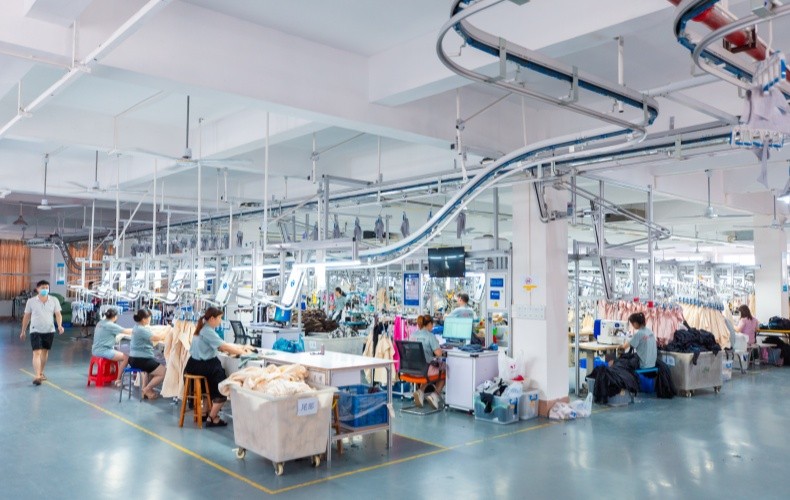
Our answer is flexible scheduling. Two facilities — one in Guangxi, one in Dongguan — total 20,000㎡ and 500,000 pieces a month, with lines split by category and a "small-order buffer" reserved inside each category's pool. A 100-piece run does not monopolize a line; it slots between bulk orders of the same fabric and shares one machine setup, amortizing changeover to near zero. That is why 100 pieces gets close to bulk pricing instead of a 2× premium. The same buffer keeps reorder lead time stable: once a style proves out, your 500–1,000-piece reorder enters the pool without waiting for a new season slot.
But know the boundary: at 100 pieces we can do custom fabric composition, custom weight, custom print, and pattern tweaks — we cannot do an entirely new composite process developed from scratch, which is priced as a development order. That is the honest line, and not every factory will tell you where it sits. For a brand scaling an outdoor clothing line, that honesty is the point: every dollar buys real capacity, not a pitch.
What 100 Pieces Actually Unlocks (Hoodie Category)
Many buyers assume a low MOQ means "take a stock style and change the label." It does not. At the 100-piece tier, here is what we can do:
Fabric
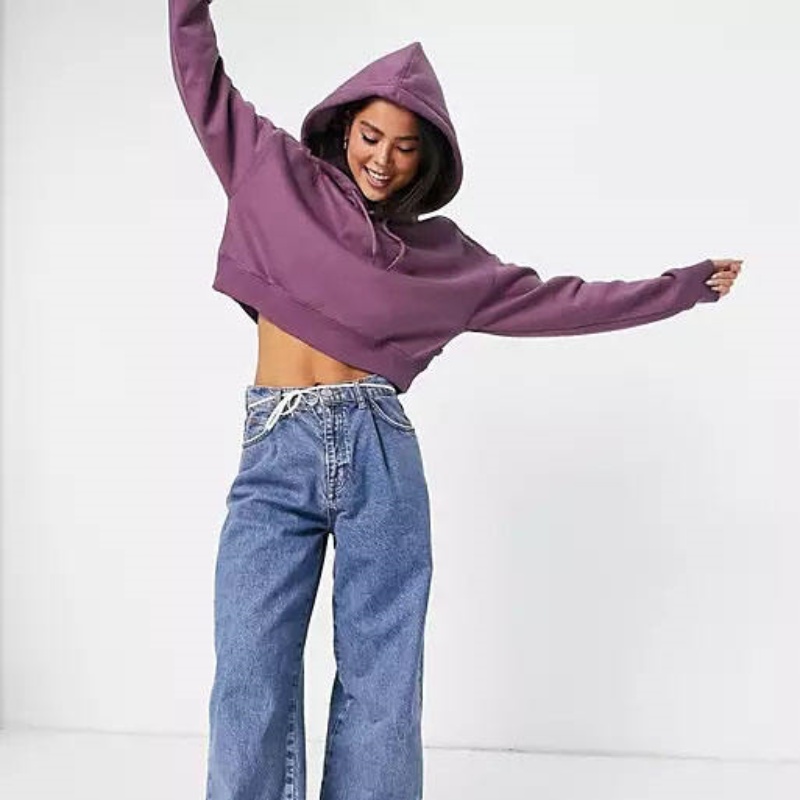
French terry 280–380GSM, brushed-back fleece, slub cotton, recycled polyester blends — all selectable, with adjustable weight, yarn count, and brushing. If you want "heavyweight street feel," 380GSM double-yarn terry is standard stock for us, no development needed.
Print & Process
Screen print, direct-to-garment, embroidery, and appliqué all run. For a 100-piece test we recommend DTG or single-color screen — the former has no plate fee and suits multi-artwork testing, the latter is cheaper for one big logo. Full-color process screen at 100 pieces is not worth it; we will tell you straight rather than take the order.
Pattern
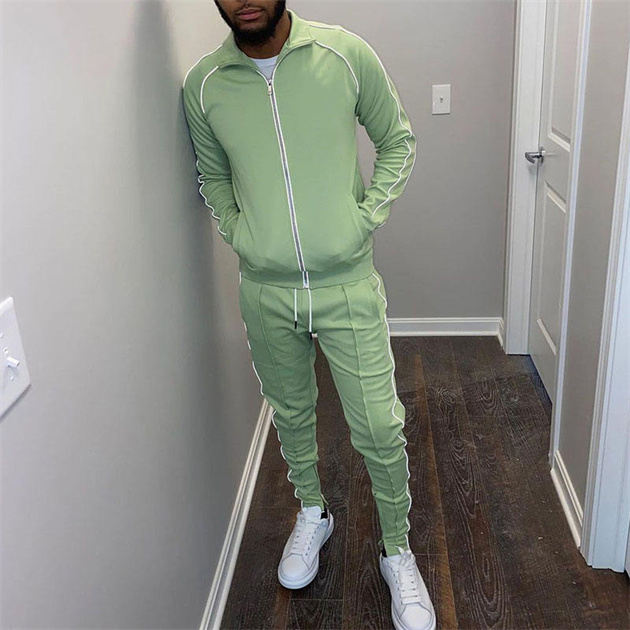
Hooded / unhooded, drop-shoulder / set-shoulder, oversized / slim, drawcord weight, pocket placement — all adjustable. We keep a library of 12 base patterns; modifying from the library beats developing from zero, and that is how a small run holds cost down while staying professionally patterned.
Labels, trims & packing
Custom woven neck labels, heat-transfer care labels, printed polybags, and branded hangtags all run at 100 pieces with low setup cost. Many growing brands underestimate this layer — it is what makes a 100-piece test read as a real product launch instead of a sample sale. Bring your logo files and we will spec the label construction to match the garment.
For a scaling brand, the MOQ's real value is not "pay less" — it is "risk less." Prove a new category at 100 pieces, then reorder 1,000. That is three times safer on cash flow than betting 500 pieces on a guess.
Workshop vs Scaled Line: Where the MOQ Gap Shows
The same "low MOQ" promise produces very different outcomes. Below is the real gap we have seen between a basement studio and a scaled 100-piece line.
| Factor | 50-piece workshop | Our 100-piece line |
|---|---|---|
| True minimum | 50, plus dev fee | 100, no hidden fee |
| Sample sealing | rarely done | sealed sample standard |
| Sampling time | 15–30 days, often outsourced | 7–10 days, in-house |
| Bulk delivery | uncertain, leftover slots | 25–35 days, locked in pool |
| Inspection | not stated | AQL 1.5 plus 8 steps |
| Certifications | varies | BSCI(B)·GRS·ISO9001·OEKO-TEX |
| Reorder consistency | color and sizing drift | sample-on-file, color controlled |
The Real Cost Structure Behind a 100-Piece Run
The trap growing brands fall into is treating "unit price" as total cost. A 100-piece hoodie's true landed cost has at least four parts:
1. Fabric. The biggest and most flexible lever. 380GSM double-yarn terry runs about 18%–25% above 280GSM standard loopback, but the streetwear weight and drape are different. A low MOQ does not mean cheap fabric — you can still spec good material; just budget "good fabric × 100 pieces" rather than back-calculating from bulk price.
2. Setup and plate fees. Print plates, embroidery punching, and marker cutting all carry one-time costs. At 100 pieces our flexible scheduling amortizes these thinly, but full-color process screen spikes the plate fee — then we usually suggest DTG to bring one-time cost near zero.
3. Sampling. First sample 7–10 days, billed separately. But against "bet 500 pieces on the pattern," a few-hundred-dollar sample is the highest-ROI insurance. Among the buyers we see, those who spend two extra rounds on sampling reorder at a markedly higher rate.
4. Logistics and shipment. We default to FOB Shenzhen. For 100 pieces, LCL or a courier sample line beats a full container — otherwise freight eats the margin. We calculate the exact routing at order confirmation.
5 Steps for a Growing Brand to Add Hoodies at 100 Pieces
- Pick one anchor style: one hero silhouette (e.g., a pullover hoodie) plus one colorway, validate the new category at 100 pieces — do not open five SKUs at once.
- Send complete specs: reference art, fabric preference (weight/handfeel), print files (vector), target size range. The more complete, the faster sampling.
- Lock the sample: 7–10 days to first fit; check pattern fit and fabric handfeel; revise, do not settle.
- Soft-launch the run: once 100 pieces land, list and measure conversion — which color, which size moves.
- Reorder on data: scale the winning color to 500–1,000 at bulk price, covered by first-wave margin, not principal.
Common Questions
Can 100 pieces really do custom print and fabric?
Yes. At 100 pieces we support custom fabric composition and weight, DTG or single-color screen print, and pattern tweaks. What we cannot do is a composite process developed from scratch — that is a development order. Everything else standard is delivered inside those 100 pieces.
Is the 100-piece price much higher than bulk?
Higher than the 1,000-piece tier, yes — but because we share machine setup through flexible scheduling, the premium is far below the industry's common 2×. The exact gap depends on fabric and print; we quote itemized up front, no hidden plate fee.
How long is sampling, and does it credit to bulk?
First sample 7–10 days, in-house pattern room, not outsourced. Sampling is billed separately and usually does not credit bulk — but against betting 500 pieces on pattern, a few-hundred-dollar sample is the best insurance. Buyers who revise two extra rounds reorder markedly more.
Do I re-MOQ on reorder, and how is lead time set?
No re-sampling — just scale up. The capacity buffer supports moving from 100 to 500–1,000 pieces instantly; lead time follows the current pool, typically still within 25–35 days. Replenishment never queues.
About the line
Two facilities in Guangxi and Dongguan, 20,000㎡ total, 500,000 pieces monthly capacity, OEM/ODM since 2014, 1,200-plus brands served. Quality follows AQL 1.5 plus an 8-step process. Certified BSCI (Grade B), GRS, ISO 9001, OEKO-TEX Standard 100. FOB Shenzhen; small orders ship by LCL or courier sample line.
Ready to add a hoodie category to your outdoor clothing line? Send your reference art, tech pack, or fabric preference. We will return an itemized quote and sampling schedule — no hidden setup fee, no MOQ trap — so 100 pieces launches the new line cleanly and scales when the data is in.