How to Vet an Outerwear OEM Factory: 5 Due-Diligence Checks
My argument up front: the weakest sentence in all of sourcing is "check the certifications." Certifications are the floor, not the ceiling — today any serious outerwear factory supplier carries BSCI, GRS, ISO 9001, and OEKO-TEX; lacking them would be the surprise. The differences that actually sink a launch live in three places buyers never look: the cutting room, the latency of a reply, and whether the factory will say no to your bad spec.
The showroom shows you the factory it wants to be. The cutting room shows you the factory it actually is.
First, puncture a fantasy. Many buyers get walked into a bright showroom — sample garments on the wall, a screen scrolling logos of past European and American clients — and relax. The showroom is designed for you to see. I have seen plush showrooms sitting above chaotic floors; that gap is exactly the signal to fear.
Check 1: Certifications are hygiene, not proof
BSCI (social compliance), GRS (recycled content), ISO 9001 (quality system), OEKO-TEX (chemical safety) must exist, but don't stop at "do you have them." My advance question is: "What year, and what BSCI grade?" This gets ignored far too often. The BSCI grade actually predicts better than "have you got BSCI" whether your order will be quietly subcontracted to an unqualified workshop — and subcontracting is the root of most "sample great, bulk disaster" stories.
Check 2: What really separates factories is the communication architecture
This is the point I weigh most, and almost no one mentions it. Not "do they reply," but who replies, within how many hours, and — crucially — whether they push back. A factory that says "no problem, we can do everything" to every request is a red flag. A genuinely experienced shop flags the unreasonable parts of your tech pack within 48 hours: a seam that won't hold, a print position that will bleed.
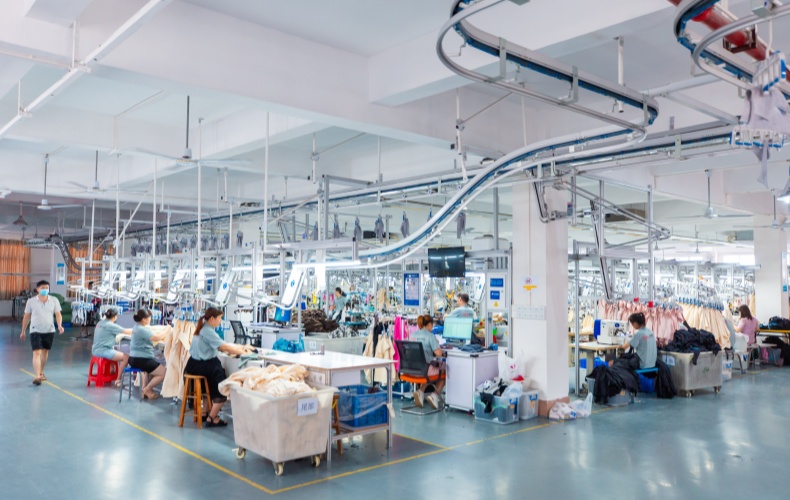
Check 3: See the cutting room, not the showroom
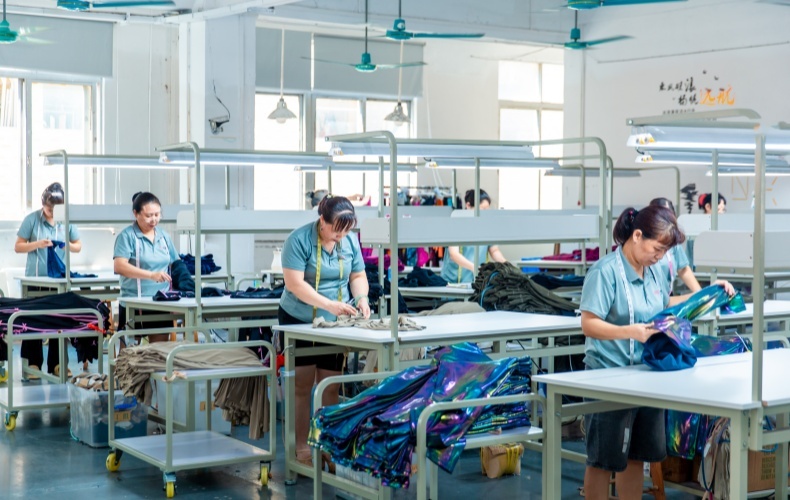
If you can, visit — or demand photos and video of — the actual production floor, not the sample wall. Figures like two plants totalling 20,000 m², over 1,000 staff, and roughly 500,000 pieces a month verify repeat-order stability: they predict whether the factory can catch your reorder when you blow up, or quietly flip you to a sub-tier.
| Showroom | Cutting room |
|---|---|
| What the factory wants you to see | What the factory actually is |
| Polished sample wall | Clean floor, orderly cutting beds |
| Client-logo screensaver | Labelled work-in-process, real WIP tags |
Check 4: A quality system you can actually see
Don't accept "we do QC." The standard to look for is AQL 1.5 with an eight-step inspection — incoming fabric, inline checks, final audit — and you should be able to see a real report.
Check 5: Honesty about geography and terms
The last check is the plainest and most decisive. Know where the goods are actually made and where they leave. A Dongguan-based factory with MOQ 100 pcs per style per colour, quoting FOB Shenzhen, is straightforward to audit and plan around. Any supplier that can't name its own facility, or muddies the Incoterms, gets a hard pass. Evasion is the signal itself.
The bottom line: due diligence is not bureaucracy, it is the cheapest insurance you will ever buy. Five checks, one afternoon, and you have turned a gamble into a managed partnership. Want our internal factory-audit checklist, or to see how we run all five checks on every line? Come see the cutting room.