How to Choose a Puffer Manufacturer: A Sourcing Checklist
How to Choose a Puffer Manufacturer: A Sourcing Checklist
Choosing a puffer / down jacket manufacturer (a puffer or down jacket supplier) is not about who quotes the lowest price — it is about whether eight things hold true at the same time: honest fill material and fill power, no inflated down content, real down-proofing, no cold spots in the quilting, traceable fabric, layering ease, sampling consistency, and a compliant lead time. A puffer looks puffy and soft, but it is actually the most "invisible-craft" hungry category — whether it leaks down and whether it still lofts after a season both hide in the fill and the baffles. Emerging and growing brands are the easiest to trap with the words "90% white duck down" and "ultra-light down," while established brands often miss the down-proofing package by staring only at unit price. At our Guangxi and Dongguan plants we set the puffer category MOQ at 100 pieces per style, backed by a dedicated down-proofing line, an independent down-filling room, and flexible scheduling rather than a cut-down factory. This article breaks the screening logic into a checklist you can use to read a factory clearly.
- 01A Real Pitfall: A Batch Trapped by the Words "90% White Duck Down"
- 02Gate 1: Fill Material — Goose, Duck or Synthetic, Do Not Get Locked by the Word "Down"
- 03Gate 2: Down Content, Fill Weight, Fill Power — Three Numbers, Do Not Mix
- 04Gate 3: Down-Proofing — Calendered Fabric and Stitch Process Are the Real Threshold
- 05Gate 4: Quilting Structure — Cold-Spot Difference Between Baffle Box and Sewn-Through
- 06Gate 5: Fabric & Traceability — GRS, REACH, OEKO-TEX
- 07Gate 6: Fit and Layering Ease
- 08Gate 7: Sampling Consistency and AQL 1.5 — the Factory's QC Baseline
- 09Three Types of Suppliers, Side by Side
- 10Lock Your Puffer Manufacturer in 5 Steps + Common Questions
A growth brand building a light winter urban-commute line wanted to make the lightweight puffer jacket its fall-winter hero — light, lofty, machine-washable, and nice on price. Brands like this usually open with "quote us a down jacket" and "what is your MOQ." But what actually decides whether this batch gets buried in bad reviews after it reaches the warehouse is the eight gates below. Start with a real lesson we have seen on the floor.
A Real Pitfall: A Batch Trapped by the Words "90% White Duck Down"
An emerging DTC winter brand launched a lightweight hooded puffer positioned for "warm urban commuting." They found a factory quoting 15% below a specialist, and the supplier's product page shouted "90% white duck down, fill power 700" in large type. Before ordering, the brand only asked about color and unit price — they never asked about fill weight or the down-proofing process. When bulk hit the warehouse, three problems exploded at once: first, the fill weight was badly short — marked 150 grams but actually under 110, so the jacket collapsed like wadding; second, down leaked severely, with feathers running out of the cuffs, collar, and front placket, and customers posting photos on social media; third, after just two washes it clumped and the fill power was essentially zero.
When the brand pushed back, the factory explained "we marked 90% on the face, but actually mixed in broken feathers and down dust, and the fill power never reached 700; for down-proofing we used ordinary high-density fabric without calendering, and never controlled the stitch pitch." That batch not only ate returns and lost money, it hit right in the winter peak season and dropped the store rating by half a grade — the brand only recovered the next year. The problem was not "the factory deliberately cheated you" — it was that this factory treated the puffer as a regular wadded jacket, with no independent down-filling room, no down-proofing line, and no fill-power testing capability. Lesson one in picking a puffer factory: do not let the words "90% white duck down" set the pace — ask clearly how much fill, how fill power is measured, and how down-proofing is done.
The most expensive part of a puffer was never the down itself — it is the down-proofing processes. Fabric can be bought ready-made; calendering and baffle construction are the real thresholds. If you cannot get a clear answer on down-proofing, you have not asked about down at all.
Gate 1: Fill Material — Goose, Duck or Synthetic, Do Not Get Locked by the Word "Down"
"Down jacket" splits into at least three paths on the manufacturing side: duck down (the most common, best value), goose down (lighter, loftier, lower odor, higher price), and synthetic insulation (such as polyester fill — machine-washable, still warm when wet, stable price). Judge whether a factory truly understands it by whether it can explain three things:
Can it tell you which fill you should use
A specialist will advise by your positioning: a light urban-commute style can use duck down or synthetic; high-altitude or ultra-light needs goose down. It will also ask about your tolerance for odor, machine washing, and price. If all you get is "don't worry, it will be warm," pass. For how to choose between synthetic and goose and their cost structures, we cover down vs synthetic fill in a companion guide within this series.
White vs grey down, duck vs goose
White or grey is only about color and has nothing to do with warmth, but light-color fabric needs white down to avoid show-through; goose down has higher fill power and lighter grease odor than duck, and costs more. A specialist will hand you the down's origin, category, and test report instead of just shouting "high loft." When you ask "is this duck or goose, white or grey, and do you have a test sheet," if they stall, the factory has no raw-material control and is only reselling.
Do you need Responsible Down (RDS)
Growth and established brands entering EU and US channels are routinely asked by downstream customers for RDS (Responsible Down Standard) or equivalent animal-welfare traceability. A specialist can support an RDS version and provide the chain-of-custody files; one that cannot explain the source will stall your compliance later — established brands especially should ask up front.
Gate 2: Down Content, Fill Weight, Fill Power — Three Numbers, Do Not Mix
The "warmth" of a puffer hides in three numbers that are constantly conflated; when screening a factory you must ask about each separately:
Down content: the share of down clusters in the fill
Down content 90% means 90% of the fill is down clusters and 10% is feather quill. Higher down content is loftier, but above 95% the cost and quality margin diminishes. The biggest inflation zone is right here — marked 90% but actually mixed with broken feathers. When auditing, ask the factory for a down-content test sheet (such as GB/T or IDFL standard), not just a verbal claim.
Fill weight: how many grams of down in one jacket
This decides the "thickness and warmth," and it is where the pitfall case above got short-changed. At the same down content, 150 grams versus 110 grams of fill weight feel worlds apart. A specialist will give a fill-weight range by size (increasing from S to XXL) and lock it in the tech pack. When you ask "what is the fill weight per size and what deviation is controlled," only one that answers with a range truly makes down jackets.
Fill power (FP): how much one ounce of down lofts
FP 550, 650, 700, 800 are common. Higher FP means loftier, lighter, and warmer at the same weight. But FP is measured (such as the IDFL cylinder method), not claimed by mouth. The "fill power 700" factory above likely had a real FP just over 500. When auditing, ask directly for the fill-power test report and "which lab, against which standard."
Gate 3: Down-Proofing — Calendered Fabric and Stitch Process Are the Real Threshold
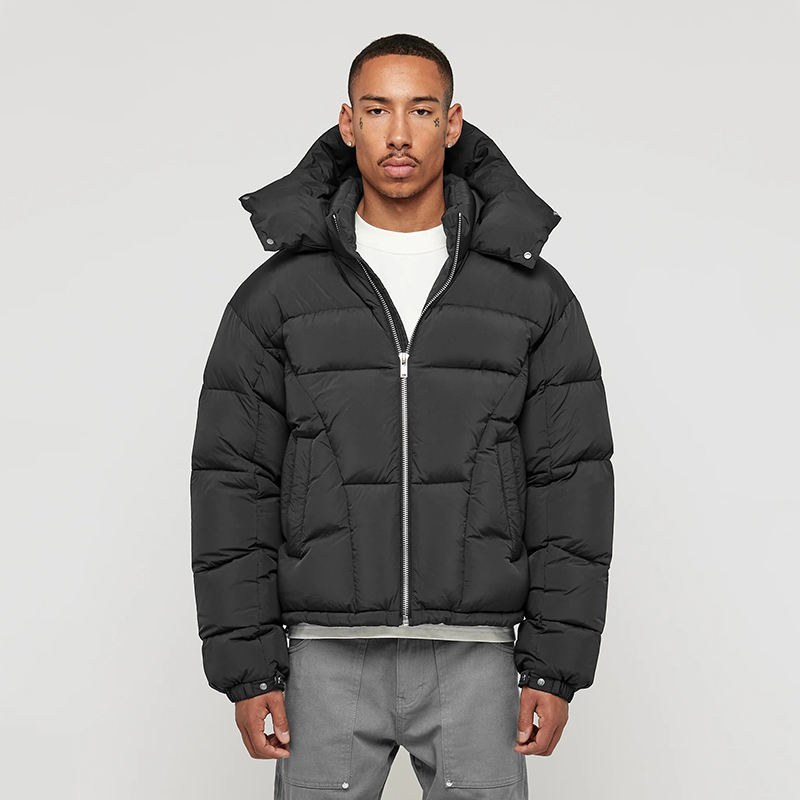
The most annoying thing about a puffer is not that it is not warm — it is down leakage, feathers running out of the seams and embarrassing the jacket and the customer together. Down-proofing relies on two layers: the fabric itself and the stitch process.
Is the fabric down-proof high-density cloth + calendering
Professional down fabric is high-count high-density (such as 20D–40D nylon), then calendered to press the surface dense so down cannot escape. One that only says "high-density nylon" without calendering will shed feathers after a few wears. When auditing, ask "is the fabric calendered, and what is the count and density" — one that cannot answer is basically using regular cloth.
Stitch density and binding
Too-sparse stitching leaves big needle holes; too-dense damages the fabric. Down lines generally control 12–14 stitches per 3 cm and bind or line the needle holes. Our dual-plant down line has an independent down-filling room and a stitch-pitch standard, with batch down-leak inspection. For how sampling actually runs and what to prepare, we wrote a companion guide, our five-step sketch-to-sample OEM/ODM playbook, you can cross-reference.
Audit cheat-sheet: Ask the factory for a photo of a down-filling workstation in action and a close-up of the calendered fabric, and eyeball whether the surface is dense and the stitch pitch is even. One that dares send and can explain the stitch pitch and calendering temperature is basically reliable; one that only sends retouched finished shots, be careful.
Gate 4: Quilting Structure — Cold-Spot Difference Between Baffle Box and Sewn-Through
The "grid" of a puffer is not pure decoration — it decides whether the down is even and whether there are cold spots. Two mainstream structures:
Sewn-through: has cold spots
Two layers of fabric are sewn directly together to form the grid; along the seam line there is no down, creating a "cold spot" with uneven warmth. It suits light, low-fill urban styles. Low cost and light, but not for extreme cold. When you see a factory doing only sewn-through yet labeling it "sub-zero warm," be alert.
Baffle box: no cold spots
Vertical baffles hold the two fabric layers apart into small boxes, so the down lofts freely inside with no seam-line cold spot — even warmth, the correct answer for high-loft down jackets. Higher cost and more complex. Our down line defaults to baffle box for mid-to-high fill styles and confirms the baffle height with the brand. When auditing, ask "is this style sewn-through or baffle, and what is the baffle height" — only one that can explain the trade-off truly understands structure.
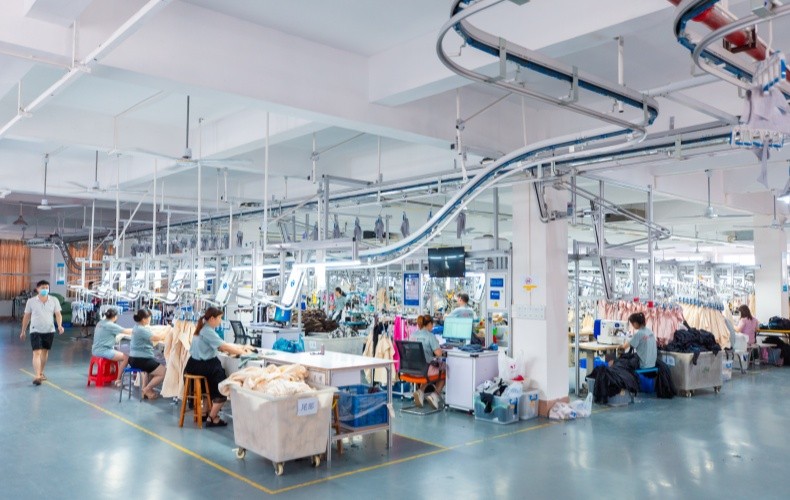
Gate 5: Fabric & Traceability — GRS, REACH, OEKO-TEX
For puffers entering EU and US channels, fabric compliance is a hard gate. Three certifications are most often audited:
GRS (Global Recycled Standard): if you run an eco line with recycled nylon fabric, the factory must provide GRS scope and transaction certificates; REACH: the EU regulation on chemicals (such as fluorinated water-repellent and dyes), and the factory must provide a SVHC (substance of very high concern) compliance declaration; OEKO-TEX Standard 100: harmless-substance testing on the finished product, which our dual plants hold. When auditing, ask directly for the certificate number and scope of application — do not be fooled by "the group has a certificate"; check whether it covers your specific fabric and process.
Gate 6: Fit and Layering Ease
A puffer is the "loft layer inside the outer layer" — usually it still needs a sweater or fleece underneath. If the pattern is built for single-layer wear, it turns tight and rides up the moment you add a layer, with the hem flipping up. A specialist allows layering ease in the puffer, adding room at the chest, armscye, and hood, and gives "recommended mid-layer thickness."
This matters especially for growth brands building a range — your knit mid-layer and your puffer need to sell as a system, and incompatible patterning means nobody buys. Our two plants have made outerwear for years; the puffer, fleece, and hoodie patterns are developed as a matched set, not each on its own. To see how we pair the outer layer with the mid-layer into one line, read our capsule outerwear line build guide.
Gate 7: Sampling Consistency and AQL 1.5 — the Factory's QC Baseline
A puffer's hidden defects are even more elusive than a hoodie's: down leakage, clumping, uneven fill, offset zippers — none visible at a glance, all exposed after a season of wear. So we use the same AQL 1.5 + 8-step QC as our shell line, and add two puffer-specific steps: a fill-weight weigh-check sample and a down-leak tumble test. The sampling step also holds to sample and bulk on the same line, same process, same QC — the sample uses baffle-box chambers, and bulk is never allowed to quietly switch to sewn-through to save cost. The sample uses calendered down-proof fabric, and bulk is never allowed to swap in regular cloth.
Three Types of Suppliers, Side by Side
Compress the seven gates above into one table; the real gap between a down specialist, a comprehensive mega-factory, and a small workshop is clear at a glance:
| Factor | Down Specialist | Comprehensive Mega-Factory | Small Workshop |
|---|---|---|---|
| Fill material control | Grades duck & goose down, issues test reports | Mostly duck down, testing often outsourced | Uses incoming material as-is, no reports |
| Down-proofing | Calendered high-density fabric + controlled stitch pitch | Has it but often mixed lines | Regular fabric, leakage common |
| Quilting structure | Baffle box optional | Mostly sewn-through | Sewn-through only |
| Fill-weight control | Locks gram weight by size, weigh-sampling | Has range but high variance | Eyeballed, high variance |
| Fill-power testing | Issues IDFL/GB reports | Vague concept | Basically untested |
| Certifications & traceability | GRS/RDS/OEKO-TEX available | Group cert, coverage doubtful | None |
| Sampling cycle | 7–10 days, in-house pattern room | 15–25 days, often outsourced | Depends on the master's schedule |
| QC system | AQL 1.5 + 8 steps + down-leak test | Generic garment QC, down easily missed | Owner eyeballs, no standard |
| Shipping & lead time | FOB Shenzhen, lockable nodes | FOB major port, long queue | Often you find your own freight forwarder |
Lock Your Puffer Manufacturer in 5 Steps
Turn the seven gates above into executable actions; keep a record at each step:
Common Questions
Is 90% down content always better the higher it goes?
Not linearly. 90% is already the mainstream high-quality threshold; going above to 95% the cost and process margin diminishes, and it demands an even stricter down-proofing fabric. For a light urban-commute style, 85%–90% down content with sufficient fill weight is more practical than blindly chasing 95%. The key is that the factory can issue a down-content test sheet, not just shout a number.
Is fill power 700 mandatory?
It depends on positioning. A light urban style is fine with FP 550–650 and cheaper; high-altitude or ultra-light needs 700–800. The point is not the height of the number but whether the factory can issue a fill-power test report and state the standard. The batch "trapped by fill power 700" above had a real FP just over 500 — FP without a report equals no claim at all.
What is the real difference between sewn-through and baffle, and is baffle required?
Sewn-through has no down along the seam line, creating a cold spot with uneven warmth, suited to low-fill light styles; baffle box (baffle) uses chambers to let the down loft freely with no cold spot, the correct answer for high-loft down jackets, but higher cost. It is not "baffle required" — your fill weight and warmth target decide the structure. A specialist advises structure by your positioning rather than one-size-fits-all.
Can a 100-piece MOQ make a custom down jacket?
Yes. At the 100-piece tier we support custom fill (duck/goose/synthetic choice), custom down content and fill weight, custom baffle structure and pattern tweaks, backed by a down-proofing line and flexible scheduling rather than relabeling stock. A composite structure developed fully from scratch is still priced as a development order, and we state that up front.
A comprehensive mega-factory quotes 15% lower — isn't that better value?
Not necessarily. The low unit price often comes from treating the puffer as a regular wadded jacket — skipping the independent down-filling room and calendered down-proofing, inflating the fill power — and the hidden return and bad-review costs ultimately land on you. The earlier case "trapped by 90% white duck down" saved 15% on the surface but lost a whole season of rating. For a craft-hidden category like down, a specialist's full-cycle cost is usually lower.
About Us (Outer-Layer OEM·ODM and Private Label Partner for Emerging, Growing and Established Brands)
We have focused on outer-layer manufacturing since 2014. Our Guangxi and Dongguan plants total 20,000㎡ with 500,000 pieces monthly capacity, holding BSCI (Grade B), GRS, ISO 9001, and OEKO-TEX Standard 100 certifications, running AQL 1.5 + 8-step QC, with the down line adding fill-weight weigh-check and down-leak tumble testing, shipping FOB Shenzhen. The puffer category MOQ is 100 pieces per style, backed by a down-proofing line, an independent down-filling room, and flexible scheduling rather than a cut-down factory. We take both private label small-batch development for brands starting out and wholesale-scale stable reorders, and both lines share the same down-proofing line and AQL 1.5 QC. To see our development process and real capacity, read our capsule outerwear line build guide.
Whether you are starting out with your own private label or replenishing wholesale, before you pick your puffer / down jacket manufacturer, get your functional requirements clear: send us your duck/goose down choice, target down content and fill weight, sewn-through or baffle, and your lead-time window. We return a first sample in 7–10 days and give you a transparent quote at a flexible 100-pieces-per-style MOQ — get a down sampling and quote plan built for your brand.