How a Puffer Jacket Factory Proves Down-Proofing: A QC Engineer's Checklist
A fabric that is called "down-proof" on a spec sheet is not proof of anything until three things line up: a calendered shell, a tight enough needle density, and a sealed seam. This checklist shows how a puffer jacket factory actually proves down-proofing, the leakage test we run on every lot, and the five lines a spec sheet must contain before you pay for a claimed "no-leak" garment.
- 01A Buyer Who Found Feathers in the Lining
- 02How a Puffer Jacket Factory Builds the Down-Proof Barrier
- 03Box Baffle vs Quilted: What a Puffer Jacket Manufacturer Should Specify
- 04Our Puffer Jacket Supplier's Down-Leakage Test on Every Lot
- 05The Down-Proof Spec-Sheet Checklist
- 06Red Flags a Puffer Jacket Factory Hides in a QC Report
A Buyer Who Found Feathers in the Lining
A streetwear buyer we later worked with had ordered 800 puffer jackets from another supplier. The fabric was labelled "down-proof nylon," the filling was "90% white duck down," and the price was sharp. Three weeks after the first wearer put one on, customers started returning jackets with feathers poking through the inner seams and the side pockets. The supplier's reply was that "down is natural, a few feathers are normal." The buyer disagreed, and so do we.
Down-proofing is not a property of a fabric name. It is the result of how the shell is finished, how the garment is stitched, and how the seams are closed. A single weak link in that chain is all it takes for a premium-looking jacket to shed feathers by week three. The rest of this article is the checklist we wish that buyer had held the first factory to.
How a Puffer Jacket Factory Builds the Down-Proof Barrier
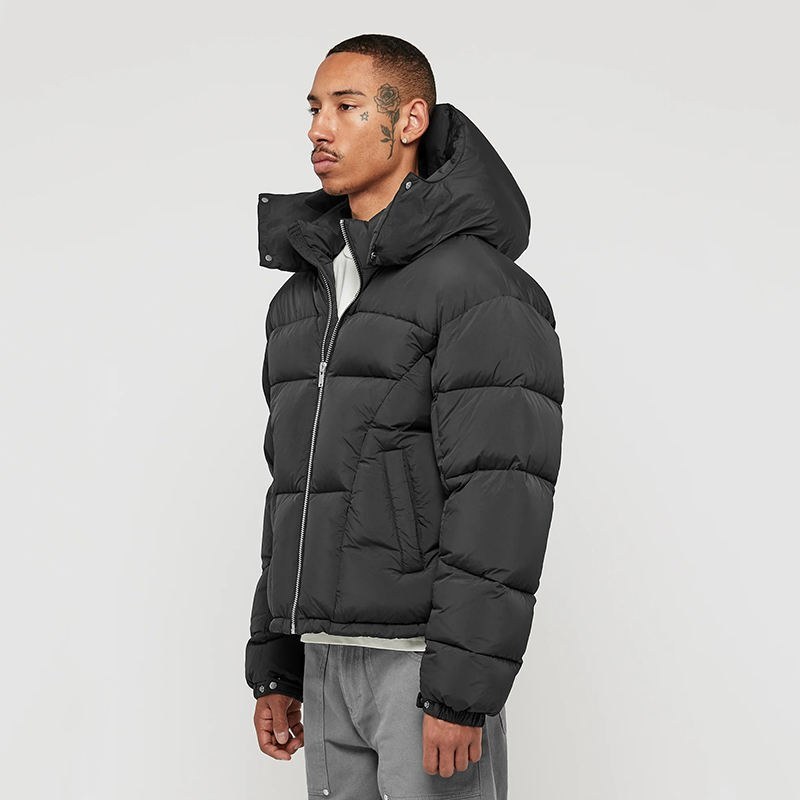
There is a popular shortcut in low-cost production: buy a tightly woven nylon, call it "down-proof," and trust the weave to hold the filling. That shortcut fails because down is made of microscopic filaments that find any gap a needle creates. A puffer jacket factory that actually controls leakage builds the barrier in three layers, and none of them is optional.
1. A calendered shell, not just a tight weave
Calendering passes the shell fabric between heated rollers to flatten and partially close the surface pores. A raw "tight" weave still leaves micro-channels; calendering closes most of them without adding a coating that would hurt the hand feel. We specify calendering as a finishing step and record the batch, because "tight nylon" with no calendering spec is the most common silent gap.
2. Needle density that respects the hole it leaves
Every stitch is a hole. A coarse needle at low density leaves a channel wide enough for filaments to migrate. We run a finer needle and a density of at least 12 stitches per 3 centimetres on down chambers, and we keep that density in the tech pack so it survives from first sample to bulk. A factory that will not write the stitch density down is telling you it is not controlling it.
3. Sealed seams on the inside of the stitch line
The third layer is a thin tape or adhesive over the inner stitch line of the down chambers, so even if a filament reaches the hole, it meets a closed wall. This is what separates a jacket that leaks from one that does not, and it is the step most often skipped to save a few cents per unit. When we say a garment is down-proof, we mean all three layers are present and recorded.
Down-proof is a three-layer system: calendered shell, controlled needle density, sealed seams. A fabric name alone proves none of it.
Box Baffle vs Quilted: What a Puffer Jacket Manufacturer Should Specify
The way the down chambers are built changes both warmth and leakage risk. Two constructions dominate, and a puffer jacket manufacturer should know which one the order actually calls for.
| Factor | Quilted (stitch-through) | Box baffle (3D channel) |
|---|---|---|
| How it is made | Outer and inner layers stitched together through the down | Inner walls create a box; down sits in a 3D channel |
| Cold spots | Present at every stitch line where down is compressed | None — loft is even across the panel |
| Leakage path | Stitch holes go straight through both layers | Stitch holes sit on inner walls, away from the outer face |
| Cost | Lower — fewer panels, simpler sewing | Higher — extra inner walls and labour |
| Best for | Lightweight layering, tighter budgets | Premium cold-weather fill, even loft |
Quilted construction is not wrong — it is just a different product. The trap is when a buyer asks for "premium warmth" and receives a quilted jacket whose stitch lines become cold spots and direct leakage paths. We default mid- and high-fill orders to box baffle and say so in the tech pack, because the construction choice is also a down-proofing choice.
Our Puffer Jacket Supplier's Down-Leakage Test on Every Lot
Claims about leakage are cheap; measurement is not. As a puffer jacket supplier we run a leakage check on every production lot before it ships, using a method aligned with the down-testing discipline described by independent labs such as IDFL. The test is simple enough to explain to a buyer and strict enough to catch a bad lot.
This is the step that turns "we use down-proof fabric" into "we verified this lot does not leak." If a factory cannot show you a leakage result with a method and a lot number, you are buying a claim.
The Down-Proof Spec-Sheet Checklist
Before you pay for a jacket described as down-proof, the spec sheet should answer five questions. If any line is missing, treat it as an open risk, not a detail.
| Spec line | What a verified sheet contains |
|---|---|
| Shell finish | Calendered nylon, with the finish recorded per fabric lot |
| Needle & density | Needle size and "≥12 stitches / 3 cm" written in the tech pack |
| Seam seal | Inner tape or adhesive on down-chamber seams, stated yes/no |
| Baffle construction | Box baffle or quilted, specified per panel |
| Leakage test | Method, lot number, and pass threshold in the QC report |
If you want the fuller picture on what the fill numbers themselves should say, our earlier piece on how a puffer jacket manufacturer verifies fill specs pairs with this one. And if you are still short-listing suppliers, the puffer manufacturer selection guide covers the questions to ask before sampling.
Red Flags a Puffer Jacket Factory Hides in a QC Report
A clean-looking QC report can still hide the things that matter for leakage. Watch for these tells.
No test method. "Passed down-proof test" with no method named is not a test — it is a sentence. A real result names what was done.
No lot number. A result without a lot reference cannot be compared to your reorder, and cannot be traced when a complaint arrives six months later.
"Down-proof fabric" with no finish spec. The fabric name carries the claim; the calendering or coating spec carries the proof. Demand the spec.
Claims instead of counts. "Very few feathers" is a feeling. "Under 3 protruding filaments per seam" is a standard. Buy the second.
No tumble result. A static panel check misses the wear that actually causes leakage. If the test did not move the garment, it did not test the garment.
About our puffer production
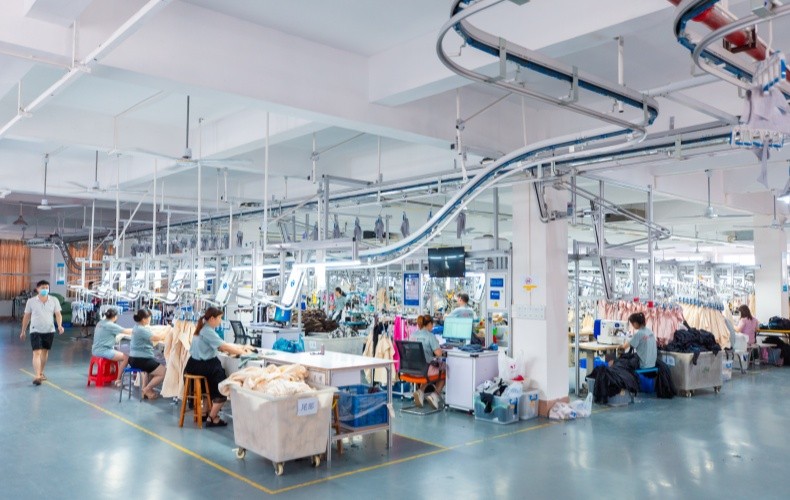
We run puffer jackets on a dedicated down line with calendering specified per fabric lot, sealed down-chamber seams, and a per-lot leakage check before shipment. For buyers planning volume, our outerwear MOQ guide explains how order size changes the production setup without changing the QC bar.
Does quilted construction always leak more than box baffle?
Not always, but the leakage path is structurally closer to the outer face in quilted builds because the stitch goes straight through both layers. Box baffle moves the stitch to an inner wall, which is why we default premium fill orders to it. A well-sealed quilted jacket can still perform; the point is to specify and verify rather than assume.
Is calendering enough on its own?
No. Calendering closes surface pores but does nothing for the holes a needle creates. Down-proofing needs the shell finish, the stitch density, and the seam seal together. A spec sheet that lists only "calendered fabric" is missing the other two layers.
What stitch density should I ask for?
For down chambers we specify at least 12 stitches per 3 centimetres with a finer needle. The exact number can shift with fabric weight, but the key is that it is written in the tech pack and checked on the line, not left to the operator's habit.
Can a leakage test be done on a finished garment?
Yes, and it should be. We tumble a finished sample and inspect the seams under light, because that reflects worn condition rather than a flat panel. Testing the panel alone misses the movement that actually drives leakage.
What is a reasonable pass threshold?
It depends on the garment tier and the agreed standard, so we set it with the buyer before bulk and record it with the lot number. The non-negotiable is that a number exists, a method is named, and the result is filed — not that a specific count is universally "right."
Send us your puffer tech pack — or let us build one — and we will spec the shell finish, stitch density, baffle construction and per-lot leakage test in writing before bulk.
Talk to our puffer team